
The Accessibility Gap: Why “Just Buy Water” Fails Disabled People, Carers, and Anyone Moving Slow
// NO DESCRIPTION DATA
Hydration
Hydration advice in the UK is full of assumptions. Carry a bottle. Pop into a shop. Refill at a station. Plan ahead.
That logic works if you move quickly, have spare cash, and your day has slack.
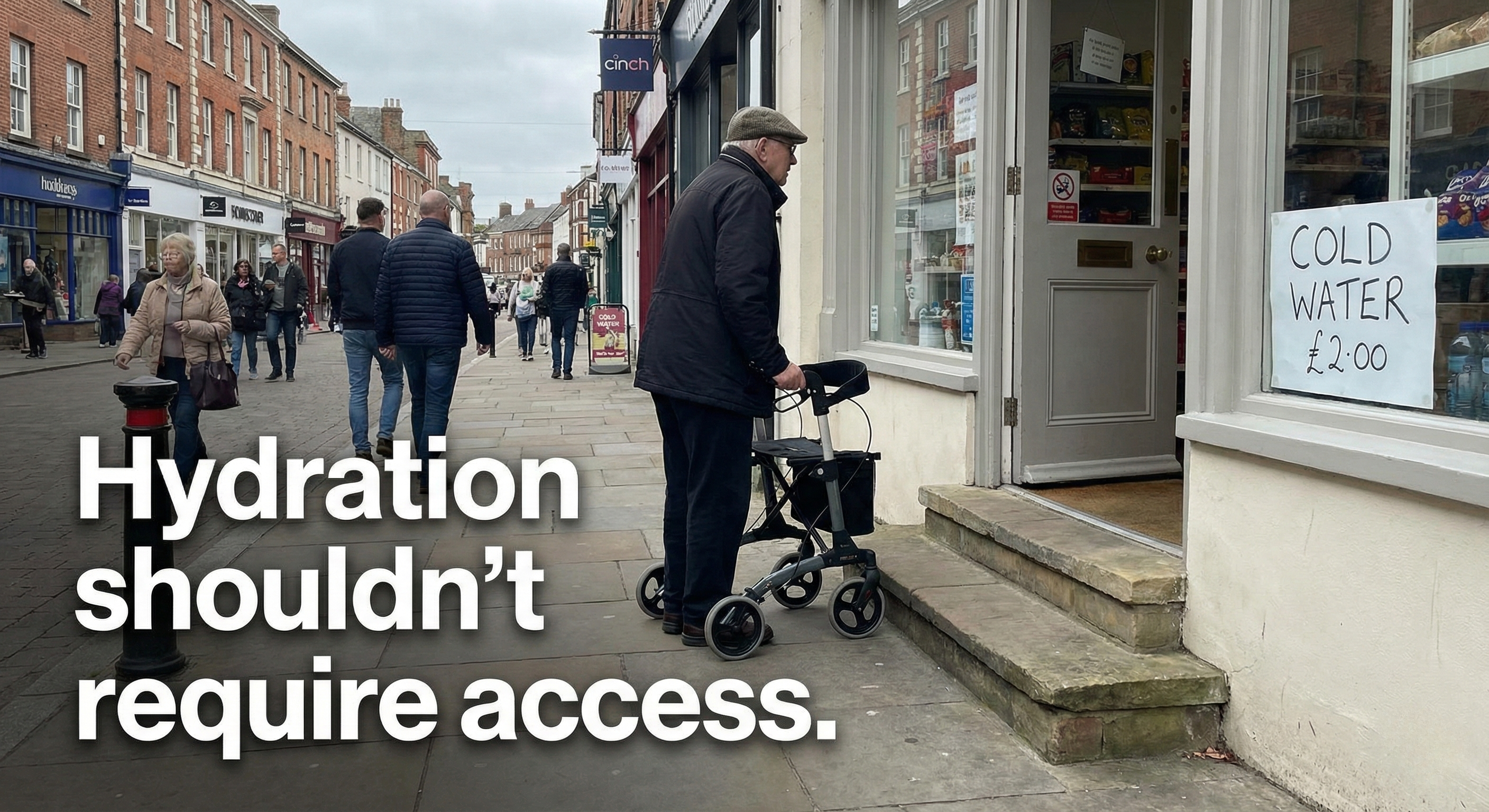
For disabled people, carers, older residents, parents with buggies, people with chronic illness, and anyone who cannot move fast or improvise easily, “just buy water” is not a neutral suggestion. It is a barrier disguised as common sense.
Freee Water CIC is being built around a simple belief: if water is a basic need, access should not depend on speed, money, or physical ease.
Accessibility is not a niche issue
Accessibility gets discussed like it affects a small group. It doesn’t. It affects everyone eventually, and it affects millions right now.
Think about the moments where hydration becomes difficult:
- You cannot stand in long queues
- You cannot carry multiple heavy items
- You cannot walk an extra ten minutes to find a refill point
- You cannot rely on public toilets or indoor seating
- You have to manage medication, fatigue, pain, or anxiety
- You are caring for someone else and can’t leave them to “pop in a shop”
In those moments, hydration becomes a problem you have to solve. Problems cost energy. Energy is already limited.
The hidden “friction tax” of hydration
Even when water is available somewhere, it can still be inaccessible.
A shop might have steps. A station might be crowded. A refill point might be broken. A venue might require purchase. A café might not let you use the toilet unless you buy something.
The result is a friction tax. Not just financial. Practical and emotional.
When you are managing disability or caring responsibilities, the friction tax shows up as:
- Overpaying for whatever is closest
- Choosing sugary drinks because they are more visible and promoted
- Skipping hydration to avoid extra effort
- Anxiety about being “a burden” when asking staff for help
None of this is a character flaw. It is a systems flaw.
Why refill alone does not cover accessibility
Refill stations are important. They are not complete.
They assume:
- You have a bottle
- Your bottle is clean
- You can reach the point easily
- The point is working
- The queue is manageable
- You have time to stop
Packaged free water matters in public life because it reduces steps. It reduces planning. It reduces reliance on perfect circumstances.
Freee Water is not anti-refill. It is pro-reality.
What inclusive hydration could look like
Inclusive hydration is not about one perfect location. It is about coverage where daily life actually happens.
High-impact accessible placements include:
- Bus stops and interchanges
- Station exits and street-level corridors
- Civic buildings and libraries
- Community hubs, advice centres, and clinics
- Campuses and youth spaces
- Event perimeters where queues form
The principle is simple: put water where people already are, not where they have to earn it.
Building this carefully, without pretending it’s solved
Freee Water is in build mode. That matters because it allows the system to be designed with accessibility in mind from the start, rather than patched later.
Early pilots can include accessibility checks such as:
- Step-free access to the stand
- Clear signage at eye level
- Simple “take one” instructions
- Placement near seating where possible
- Reporting channels for issues and barriers
Success is not only litres distributed. It is whether people who struggle most with access actually benefit.
Why this angle matters for partners
For councils, venues, and local organisations, accessible hydration is a practical public health support. It reduces avoidable strain and improves the daily experience of public space.
For brands and sponsors, when that layer comes later, accessibility is also credibility. It is the difference between “a nice campaign” and “a useful piece of infrastructure.”
Hydration should not reward the fastest. A wealthy country should do better than that.
UK Regulatory & Legal Framework for Public Water Access
Public hydration access across the United Kingdom operates within a fragmented statutory environment. Under The Licensing Act 2003 (Mandatory Licensing Conditions) Order 2014, licensed on-trade premises such as pubs, bars, and restaurants are legally required to provide free potable tap water to customers where reasonably available. However, because this legal mandate applies exclusively to paying or recognized patrons, it inadvertently establishes an exclusionary “pay-to-function” commercial barrier for the broader public navigating high streets, public transport corridors, and town centres.
According to nationwide behavioral data published by Refill UK and the City to Sea campaign, over 71% of UK consumers feel acute psychological stigma and social hesitation when requesting free tap water in commercial venues without making a purchase. Furthermore, under the Water Industry Act 1991 (Sections 181 and 182) and guidance from the Drinking Water Inspectorate (DWI), municipal local authorities bear no statutory duty to install or maintain public outdoor drinking fountains. Faced with severe budgetary deficits, local councils frequently decommission municipal water fountains due to winter freezing liabilities, pipework deterioration, legionella testing requirements, and anti-social behavior risks.
Hydration Channel & Economic Footfall Comparison
To examine why conventional public infrastructure struggles to provide reliable, stigma-free hydration across UK urban centres, we compare the primary access channels across physical accessibility, consumer friction, and municipal maintenance:
| Hydration Channel | Accessibility / Cost | Stigma Level | Maintenance Burden |
|---|---|---|---|
| Commercial Venues (Cafes/Pubs) | “Pay-to-function” barrier (£2.50–£4.50 purchase barrier) | High (71% social hesitation) | Low (Customer-funded hospitality staff) |
| Municipal Fountains | Free, but high freeze, lead-pipe & vandalism risk | Low | High Council Maintenance & Winter Shutdowns |
| FreeeWater Faith / Community Mesh | 100% Free, Heated, Staffed & Welcoming | Zero Stigma (Open-Door Civic Hospitality) | Community-Partnered & Sponsor-Funded |
Civic Infrastructure Topology & Community Mesh Flow
The FreeeWater community mesh leverages existing civic architecture, faith institutions, municipal libraries, and community hubs to distribute free hydration with zero taxpayer expenditure. By situating sustainable paper-carton dispensers directly inside community warm spaces, the network solves both physical access constraints and social stigma.
[ Local Resident / Passerby ] ──► [ Faith / Community Hub ] ──► [ FreeeWater Dispenser ]
                                         │                              │
                                         ▼                              ▼
                              [ Warm Space & Dignity ]      [ Zero Plastic Waste ]
Operational Lifecycle & Verified Environmental Impact
Civic hydration initiatives often falter during operational scaling due to plumbing maintenance overheads and regulatory water safety compliance. When traditional outdoor fountains freeze or become contaminated, local councils face months of procurement delays. The FreeeWater ecosystem bypasses centralized utility gridlocks by supplying pre-packaged, hermetically sealed paperboard cartons directly to verified distribution hubs.
Every FreeeWater unit is packaged in FSC-certified paperboard laminated with a thin plant-based barrier, generating 64% fewer greenhouse gas emissions across its lifecycle than standard virgin PET bottles. Ethical brand partners sponsor the outer packaging canvas, turning essential public utility into a high-recall communication channel. In turn, 10p from every distributed carton is transferred directly to the Feed and Flow Foundation to build permanent clean water infrastructure globally.
Oliver Green
Verified AuthorLead Technical Writer & Civic Hydration Specialist • FreeeWater Impact Research
Lead technical writer and community infrastructure analyst at FreeeWater. Researching civic hydration accessibility, UK water regulatory policy, circular packaging lifecycle analysis, and community-driven utility models.
Explore Related Hydration Dispatches
Continue reading connected technical guides and community case studies.
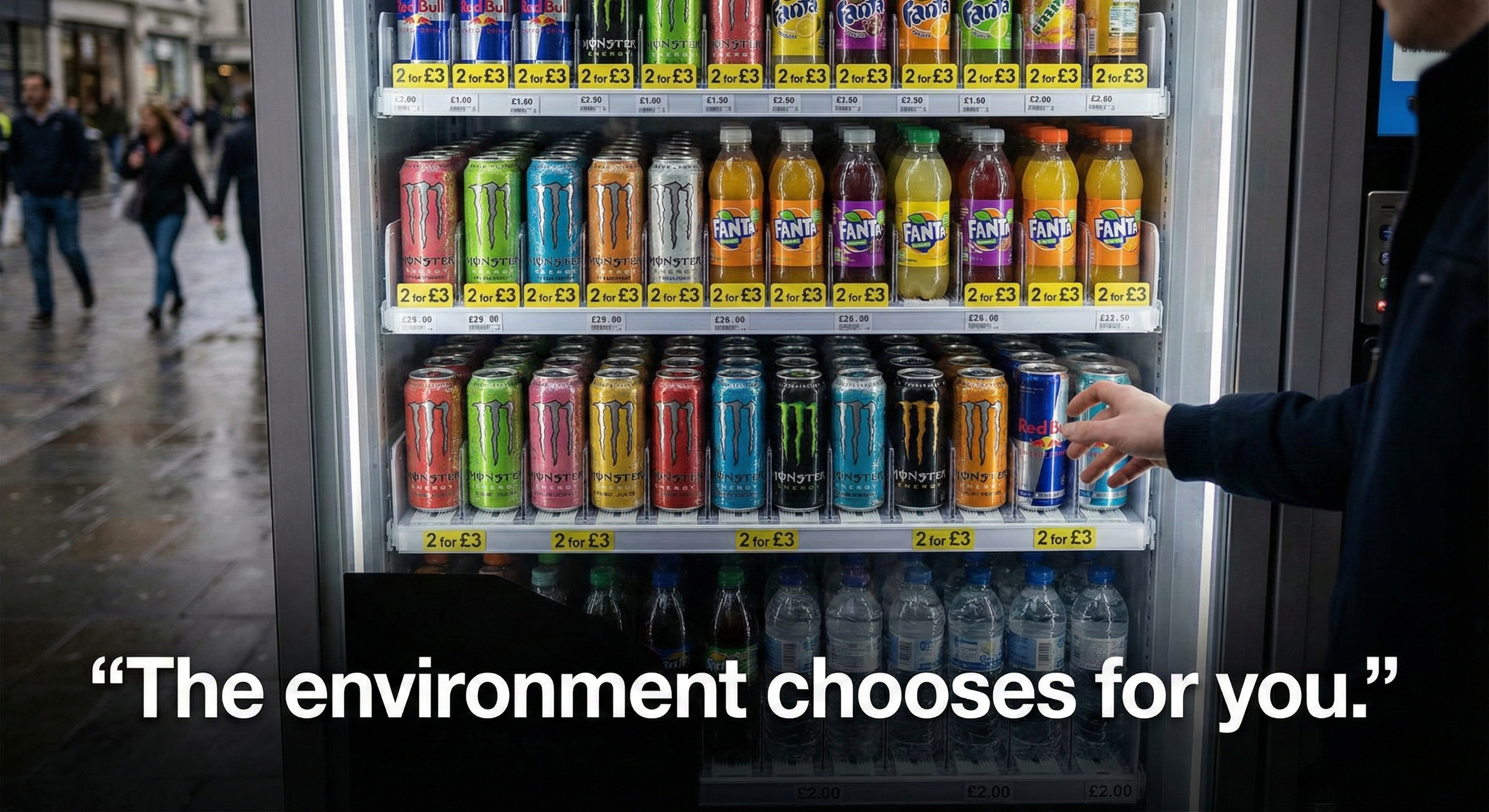
Why People Buy Sugar First: The Choice Architecture Problem on UK Streets
Public health Public health messaging often blames individuals. Drink more water. Make better choices. Cut hoo...
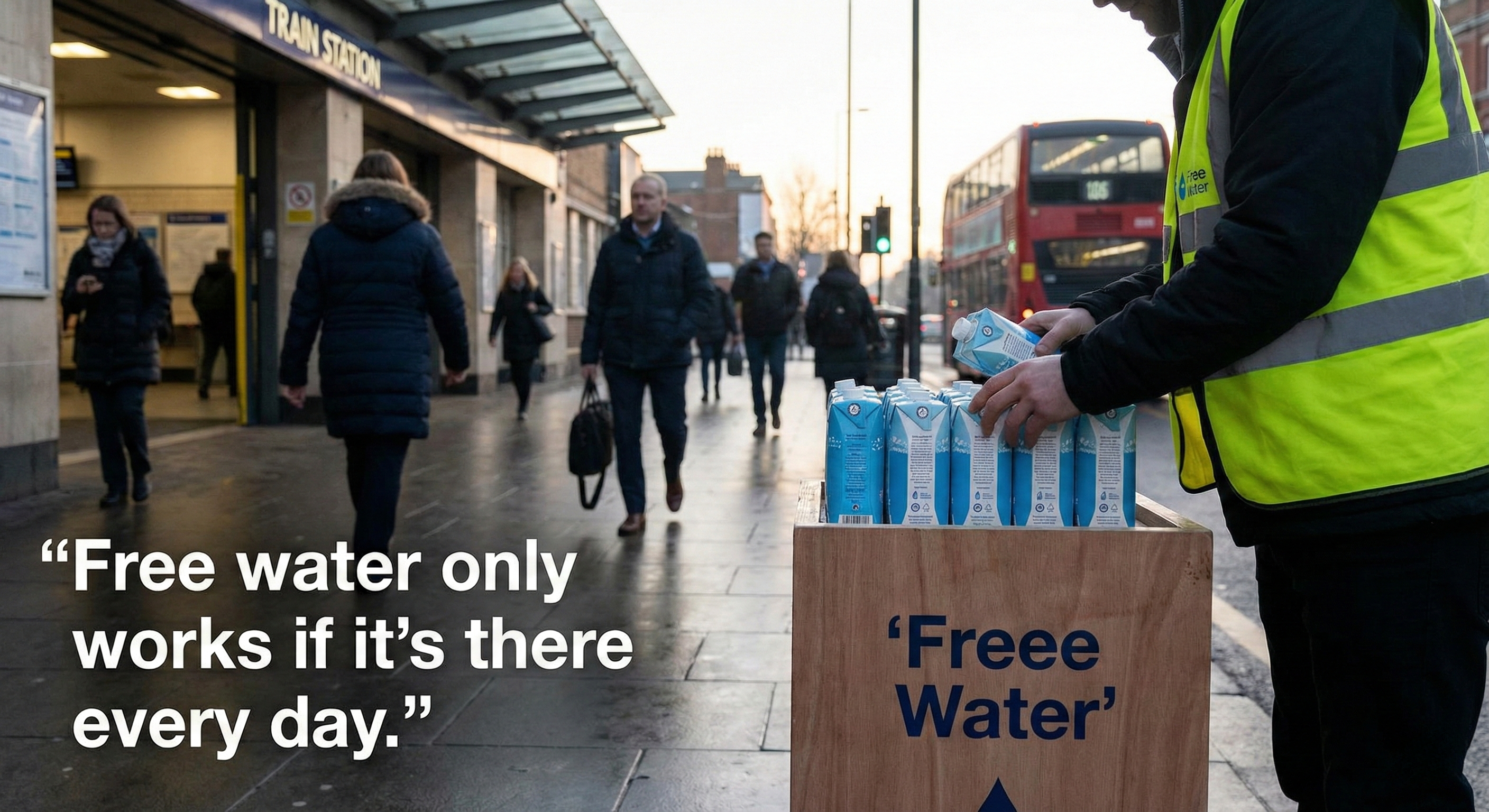
Free Water Isn’t Free To Deliver: The Real Logistics Behind Freee Water
Free Water Free water sounds simple until you try to deliver it at scale. In Britain, hydration is treated lik...
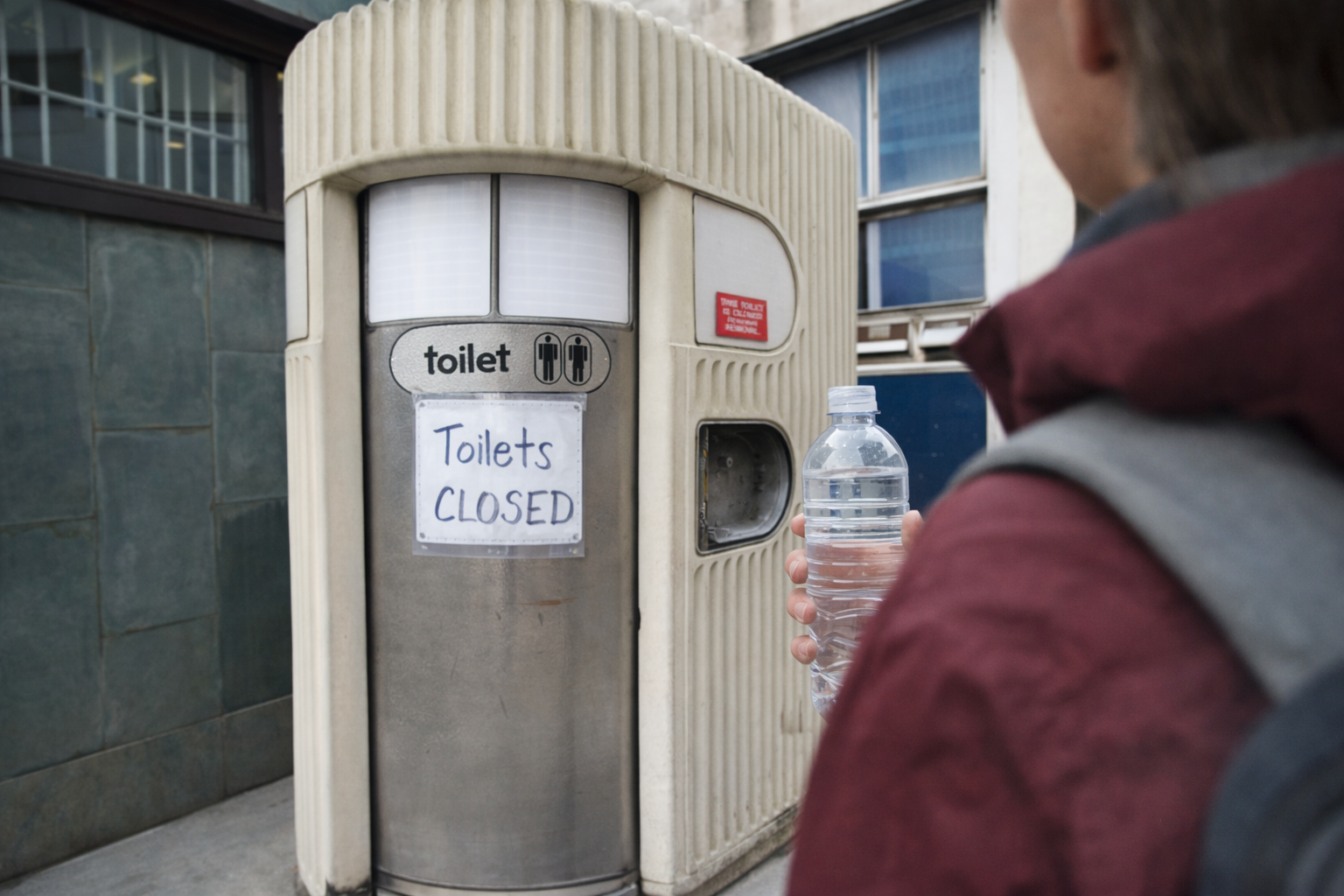
Water + Toilets: The Missing Pair in UK Public Space Design
Freee Water Free water sounds simple until you remember the other half of the equation. If you drink more wate...