Why Brands Are Backing Freee Water: High Impact Advertising With Real Community Value
// NO DESCRIPTION DATA
Why Brands Are Backing Freee Water
Marketing budgets are under pressure. At the same time, audiences are more sceptical than ever about what brands actually stand for.
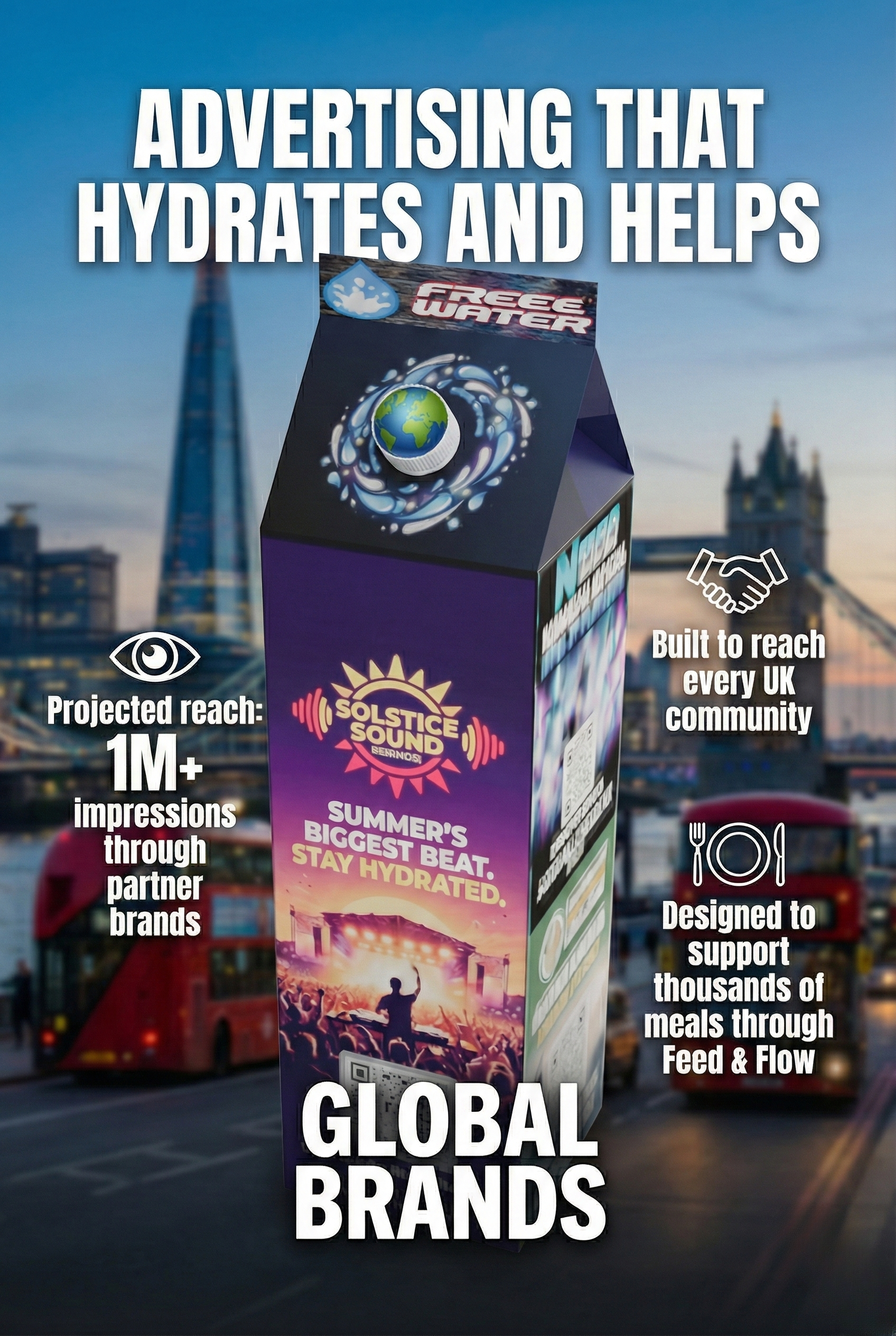
Freee Water CIC offers a different kind of media space. It turns every sponsored carton into three things at once:
- A useful object in somebody’s hand
- A visible message in the real world
- A contribution to a long term community support model
This post explains why brands are choosing to appear on Freee Water packaging and how that decision connects directly to both hydration access and food support through Feed & Flow Foundation.
The problem with traditional campaigns
Standard advertising channels compete for attention in crowded spaces:
- Endless feeds and timelines
- Overloaded digital billboards
- Ads people scroll past without really seeing
Even when a campaign is technically successful, it can still feel disconnected from everyday life. A logo on a screen does not automatically equal real world impact.
When households are juggling rent, food, energy and travel, it can also feel out of step to spend six figures on views that do not translate into anything tangible for the communities a brand serves.
Freee Water as a real world impact channel
Freee Water CIC is built on a simple trade:
- Brands pay to appear on cartons or reusable bottles
- That sponsorship funds free water for the public
- Surplus in time helps fund food support through Feed & Flow Foundation
For a brand, this means that the same budget that would normally buy impressions buys:
- Free hydration where people actually need it
- A visible commitment to tackling cost of living pressure
- A long term link to food security support in the UK
It is not an add on campaign. It is the core of how the channel works.
What brands get from a Freee Water campaign
A Freee Water partnership gives brands more than a logo in circulation. Key benefits include:
1. High trust, high relevance placement
People pick up Freee Water because they need it. The brand appears on something useful, at a moment when the person is glad it is there. That is very different from interrupting a video or feed.
2. Physical presence in real communities
Freee Water focuses on:
- City centres
- Commute routes
- Events and local gatherings
- Outreach and community spaces
This puts sponsor branding where real life happens, not buried in an algorithm.
3. A clear social impact story
Each campaign can be linked to:
- The number of cartons produced
- The approximate number of people hydrated
- The share of future surplus feeding into Feed & Flow Foundation
Brands can talk concretely about what their spend unlocked, not just how many impressions were served.
4. Alignment with ESG and CSR goals
For companies with environmental, social and governance commitments, Freee Water offers a way to:
- Support hydration access in the UK
- Contribute to future food security projects
- Back a social enterprise and a charity working in partnership
It connects marketing budgets to measurable community benefit.
How a sponsor campaign is structured
While details adapt to each partner, a typical sponsorship with Freee Water CIC involves:
Co design of artwork
- Brand message and identity
- Clear Freee Water CIC branding
- Optional reference to Feed & Flow Foundation and food support
Definition of scope
- Volume of cartons or bottles funded
- Likely locations and types of distribution
- Duration of the campaign
Transparency on outcomes
As reporting structures develop, Freee Water CIC will share:
- Total units produced under the campaign
- Distribution overview by area
- Headline impact metrics as the model grows
The aim is always the same: brands know what they paid for, communities see the benefit and the link is clear.
Why this matters for audiences
People notice when a campaign is doing something practical.
When someone picks up a Freee Water carton, they know:
- It is free because a brand chose to fund it
- It is part of a CIC structure built for community benefit
- Over time, this model will help support food projects through Feed & Flow Foundation
Even if they never scan a QR code, the connection between brand and benefit is present each time they take a drink.
The environmental piece
Freee Water CIC is committed to keeping environmental impact front and centre:
- Focusing on eco friendly cartons where possible
- Developing reuse through metal bottles and refill models
- Building distribution in ways that minimise waste
For brands, that means they are not being asked to compromise environmental principles in order to support hydration access and food security.
A long term partnership opportunity
The goal is not one off campaigns that vanish after a quarter. The long term vision is:
- Multi run partnerships with sponsors
- City wide and regional rollouts
- Integrated stories that connect water access, food support and local communities
As Freee Water CIC and Feed & Flow Foundation grow, early brand partners will be part of the story from the beginning.
How brands can get involved now
Freee Water CIC is in its build and launch phase. This makes it an unusually high leverage moment for brands that want to do more than write a cheque.
Early partners can:
- Fund the first production runs that prove and refine the model
- Shape how sponsorship appears on packaging and in reporting
- Help accelerate the link between free hydration and food support in the UK
For marketing teams, ESG leads and founders, this is a chance to align brand visibility with something simple and powerful: making sure that in a wealthy country, people are not skipping hydration or meals because the basics have turned into luxuries.
Freee Water CIC exists to fix that. Feed & Flow Foundation exists to push the support further. Brands that back them are not just buying space. They are helping build a system.