No Cash, No Card, No Battery: The Cashless Hydration Trap in UK Public Space
// NO DESCRIPTION DATA
The UK Went Cashless. Water Didn’t Get Easier.
We’ve quietly built a country where you can exist in public, but only if you can transact in public.
Tap to pay. Scan an app. Download a loyalty scheme. Keep your phone alive. Keep your bank working.
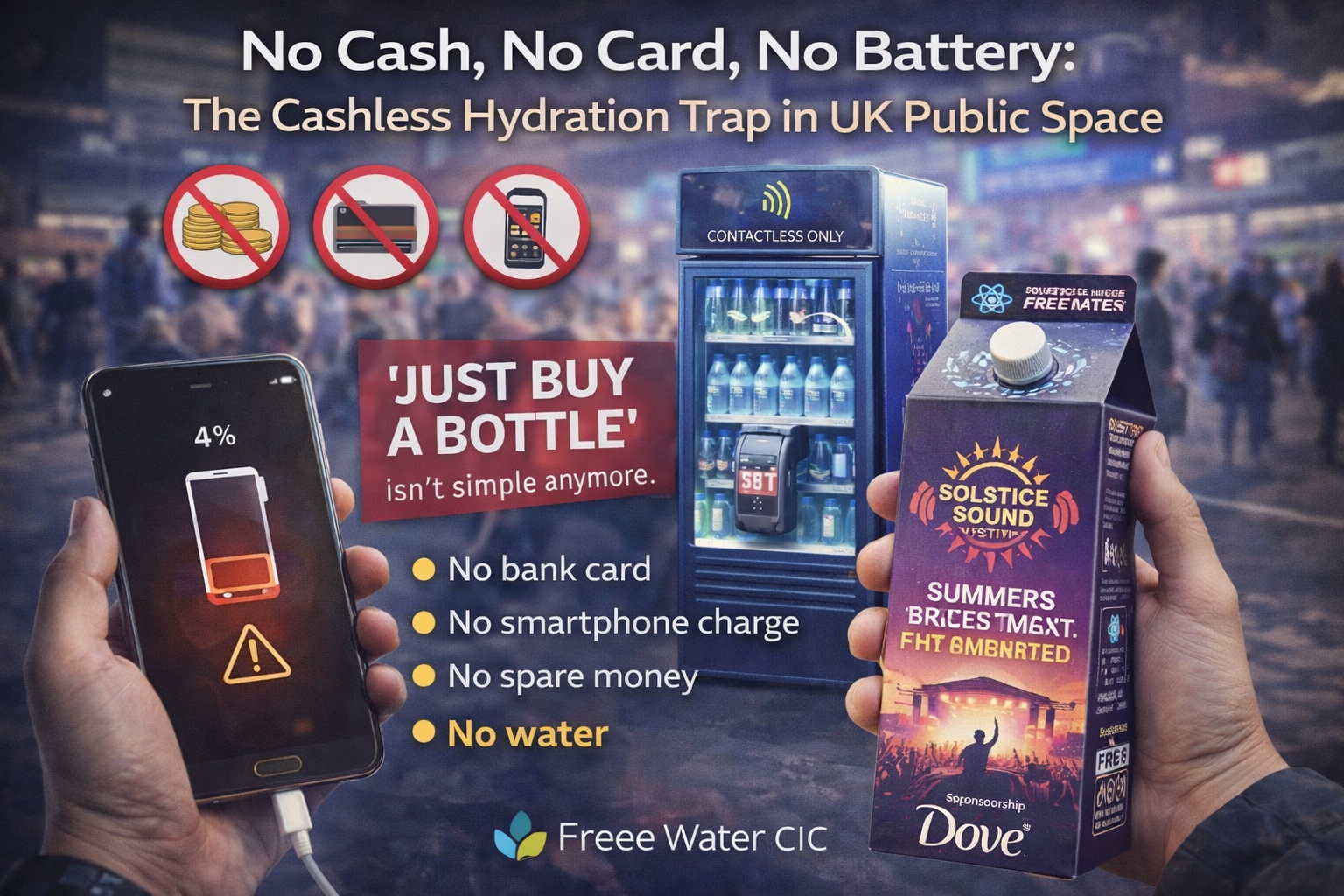
Now apply that to water, the most basic thing you can need outside. Suddenly “just buy a bottle” isn’t a simple solution, it’s a system that assumes everyone has:
- a working bank card
- a charged smartphone
- signal
- spare money
- and the time to queue
When even one of those breaks, hydration becomes a stress problem, not a health habit.
Who the Cashless Model Leaves Behind
It’s not just “people who forgot their card.” It’s people whose day is already fragile:
- people relying on cash
- people with unstable banking access
- people living day-to-day
- people trying to avoid micro-spends
- people with low battery and no charger
And yes, some people use cash because they literally don’t have a bank account. That’s not a moral failure. It’s a design reality. In the FCA’s UK payments research, one of the listed reasons people pay with cash is: “Because I don’t have a bank account.”
So when water is only available behind a payment wall, the system is basically saying:
“If your tools fail, your body fails too.”
The “Battery Tax” Nobody Talks About
The cashless city runs on one hidden dependency: your phone staying alive.
Low battery changes behaviour fast:
- you avoid spending time looking for things
- you avoid detours
- you avoid queues
- you avoid anything that might drain the last 5%
So you pick the quickest option or you skip water entirely. This is why public hydration needs to be frictionless, not “available somewhere”.
Why This Matters for Public Health and Cost of Living
Paying £2 for water isn’t just annoying. It’s a repeated drain.
Micro-purchases stack up because they’re emotionally invisible:
- “It’s only £2.”
- “I’ll just grab one.”
- “I can’t deal with this right now.”
That’s how hydration becomes a subscription you never agreed to.
What “Free at the Point of Use” Actually Fixes
Freee Water isn’t trying to guilt people into better habits.
It’s designing around actual UK behaviour:
- people forget bottles
- people don’t want to ask staff
- people don’t want to queue
- people don’t want another tiny cost
- people don’t have time to hunt for a fountain
So the model is simple:
remove the transaction moment and hydration becomes normal again.
Where This Matters Most
This cashless hydration trap shows up hard in:
- stations and commuter corridors
- job centres and civic waiting spaces
- hospitals and clinic routes
- high streets where people drift between errands
- campuses and public buildings
These are the places where “being outside” already costs effort. Water shouldn’t add another layer.
The Real Standard for Modern Cities
A modern city doesn’t just accept cashless life.
It builds safety nets for it.
Water should be one of those.