Event Hydration Without Refill Stations: A Better Mobile Model
// NO DESCRIPTION DATA
Refill stations are useful, but they are not the whole answer
The UK conversation around water access often gets trapped in one model: refill infrastructure.
Bring a bottle.
Find a fountain.
Top it up.
Problem solved.
That works in some places. It is not useless. London has backed both refill schemes and public drinking fountains, and City Hall says the Mayor, partners, and funders have already supported a network of drinking fountains and bottle refill stations across the capital.
But event environments are not the same thing as permanent urban infrastructure.
Events are temporary.
Flows change.
Queues build.
Crowds move.
Entry points matter.
And not everyone has a bottle with them in the first place.
That is where a mobile model becomes stronger.
Events need water where people actually are
UKHSA’s event guidance says organisers should ensure an adequate supply of drinking water throughout the event and that, on hot days, it is advisable to provide free drinking water. It also says water should be well signposted and safe to drink.
That guidance is practical, not ideological.
It does not say every event must become a fixed refill network. It says organisers need adequate supply and clear access. Mobile free water distribution can meet that need in a very different way from a fixed fountain or refill point.
That difference matters because fixed assets are not always where the pressure points are.
Sometimes the right place is:
the queue,
the gate,
the registration zone,
the arrival area,
the route between programme points,
or the high-footfall edge of a family event.
A mobile format can go there.
A fixed fountain cannot.
A mobile model works for real event behaviour
People do not behave at events the way sustainability posters imagine they do.
Not everyone arrives prepared.
Not everyone carries a reusable bottle.
Not everyone wants to hunt for a fountain.
Not everyone sees the signage.
And not every event has the layout, plumbing, cost tolerance, or setup window to install temporary refill infrastructure properly.
That is why mobile event hydration matters.
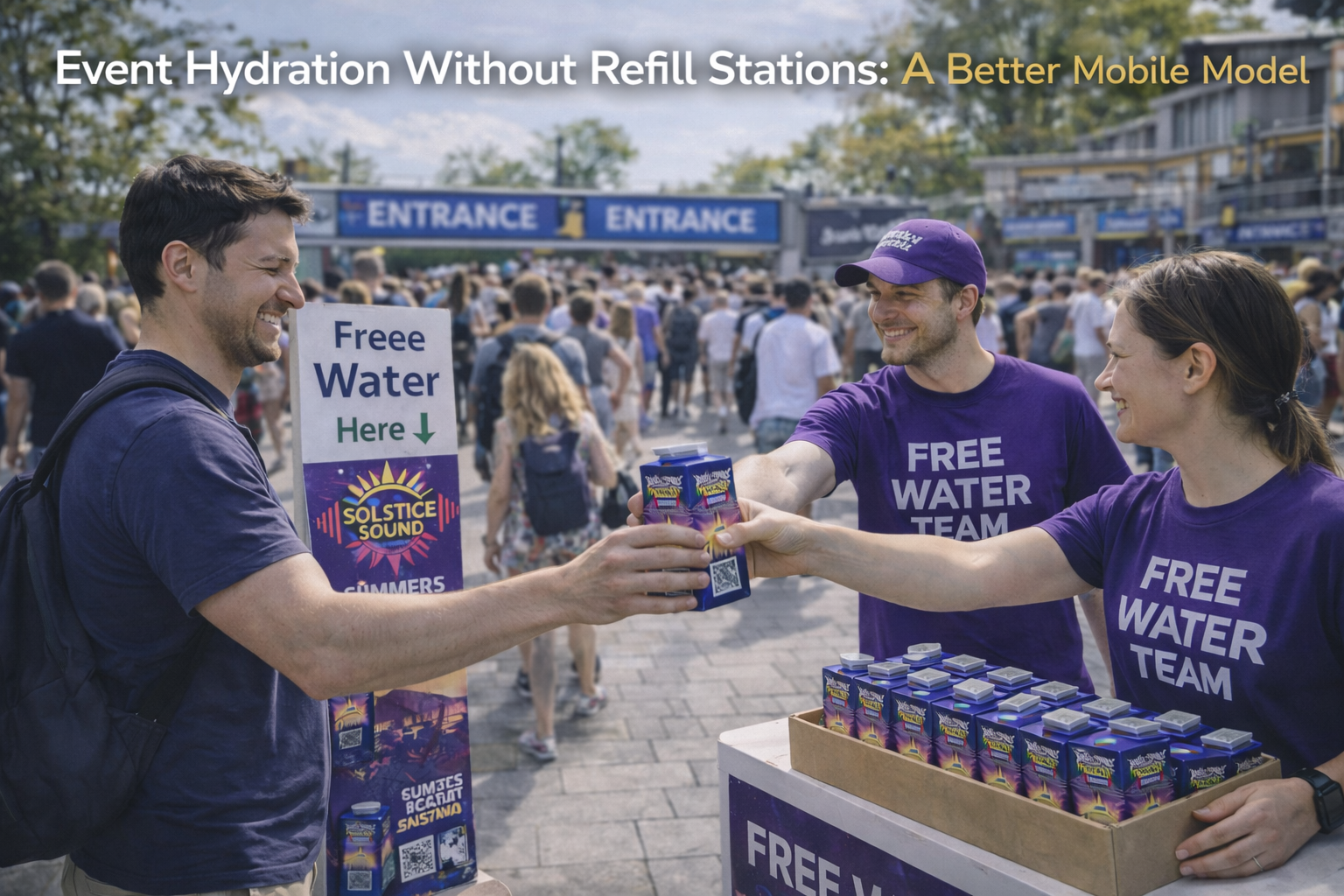
Freee Water fits this better because it meets the crowd where the crowd already is. It does not require a behaviour change first. It does not require the guest to have packed correctly. It does not depend on one fixed location doing all the work.
That makes it commercially sharper too. The sponsor message is attached directly to access, not only to infrastructure.
The sponsor story is cleaner with mobile distribution
A refill station is infrastructure-led.
Freee Water is interaction-led.
That difference changes the brand value.
With a fixed refill point, the sponsor may get association with the asset, but the interaction is less direct and depends on people choosing to find and use the station.
With mobile distribution, the brand becomes part of the actual handover. The carton is seen, held, used, photographed, and carried. The sponsor is no longer just supporting an object in the background. The sponsor is present at the point of benefit.
That creates a stronger activation format for events where visibility and usefulness both matter.
This is not anti-refill. It is pro-fit
This needs saying because people get weirdly tribal about water formats.
Freee Water does not need to argue that refill stations are bad.
The better point is that refill stations and sponsor-funded mobile water solve different problems.
Refill is stronger where people already have bottles and permanent infrastructure makes sense.
Mobile free water is stronger where the event is temporary, the crowd is moving, and the point of need shifts throughout the day.
Those are not the same operating conditions.
Trying to force every event hydration conversation into the refill lane is like insisting every transport problem must be solved by the same vehicle. Humans love that kind of lazy systems thinking. It is one of their less charming habits.
Why this model fits Freee Water
Freee Water is not trying to become a fountain network.
It is not a permanent refill map.
It is not a static utility asset.
It is a sponsor-funded, daytime, event-ready format that works in the places where the event experience actually happens. That is why it makes so much sense for arrivals, queues, walk-heavy grounds, welcome zones, and high-footfall daytime settings.
The model is cleaner because it accepts what events really are:
temporary,
movement-heavy,
and dependent on timing.
That is why event hydration without refill stations is not a compromise.
In many cases, it is the better mobile model.