The “Free Tap Water” Law That Still Leaves You Thirsty Outside
// NO DESCRIPTION DATA
Introduction
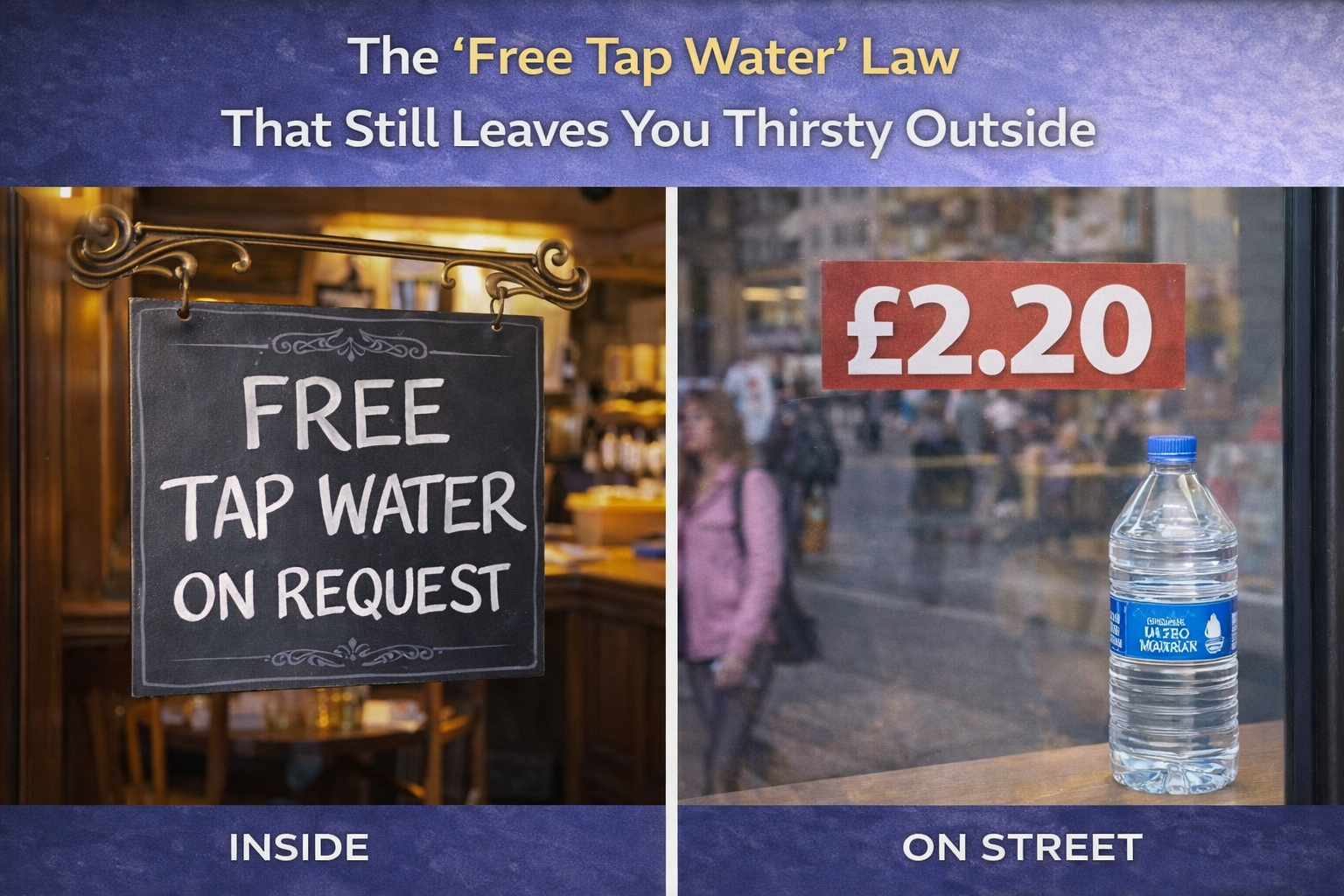
The UK has a weird contradiction baked into law and culture at the same time. In many places, you can legally request free drinking water, but in the places people actually move, commute, and wait, water still defaults to a purchase.
That gap is where Freee Water sits: not replacing tap water, but filling the real-world “outside” problem.
The law exists, but only in a specific lane
In England and Wales, licensed premises have a mandatory condition to provide free tap water on request where it’s reasonably available.
This was designed around alcohol licensing, safety, and responsible service, not everyday hydration in public space.
So yes, the rule exists. But it’s aimed at a narrow environment.
Why it doesn’t solve the public hydration gap
Even if “free water on request” exists in some venues, it still fails in real life because it’s not frictionless:
- You need to enter a premises
- You need to ask
- You may face queues, staff refusal, or awkwardness
- It’s not guaranteed in places without alcohol licensing
And crucially: the law does not create a consistent hydration layer across streets, transport corridors, parks, or civic spaces.
The public space problem is structural
A parliamentary committee on plastic bottles pointed out the lack of obligation for unlicensed premises and highlighted the role of more free water access in public spaces.
The point is simple: the legal baseline isn’t designed for modern movement patterns.
The UK has built cities where you can buy almost anything instantly, but you can’t reliably drink water instantly unless you pay.
Why “just refill” isn’t the full answer
Refill points are good. But they assume:
- You have a bottle
- You remember it
- You have time to detour and queue
- The tap is working and accessible
That’s not how people behave on a normal day. Public health doesn’t scale on perfect habits.
What Freee Water adds to the system
Freee Water is a practical add-on layer: sealed, grab-and-go hydration that removes the “ask” and removes the “checkout” moment.
Not a replacement for taps. A backup option that matches how people actually move.
Why this matters for sponsors and councils
This post is not just moral framing. It’s operational:
- Councils need predictable hydration access as part of a modern public realm
- Sponsors want visibility tied to something people genuinely value
- The public wants one basic thing to stop being a micro-transaction
A city can have tap-water rights and still have a hydration problem. That’s the gap Freee Water is built to close.