Freee Water Host Guide for Events, Markets and City-Centre Sites
// NO DESCRIPTION DATA
Hosting Freee Water starts with the role of the site
A host does not need to become a water utility, and that is one of the most important things to get straight early.
Freee Water is not a permanent refill installation.
It is not a charity handout.
It is not an accidental add-on.
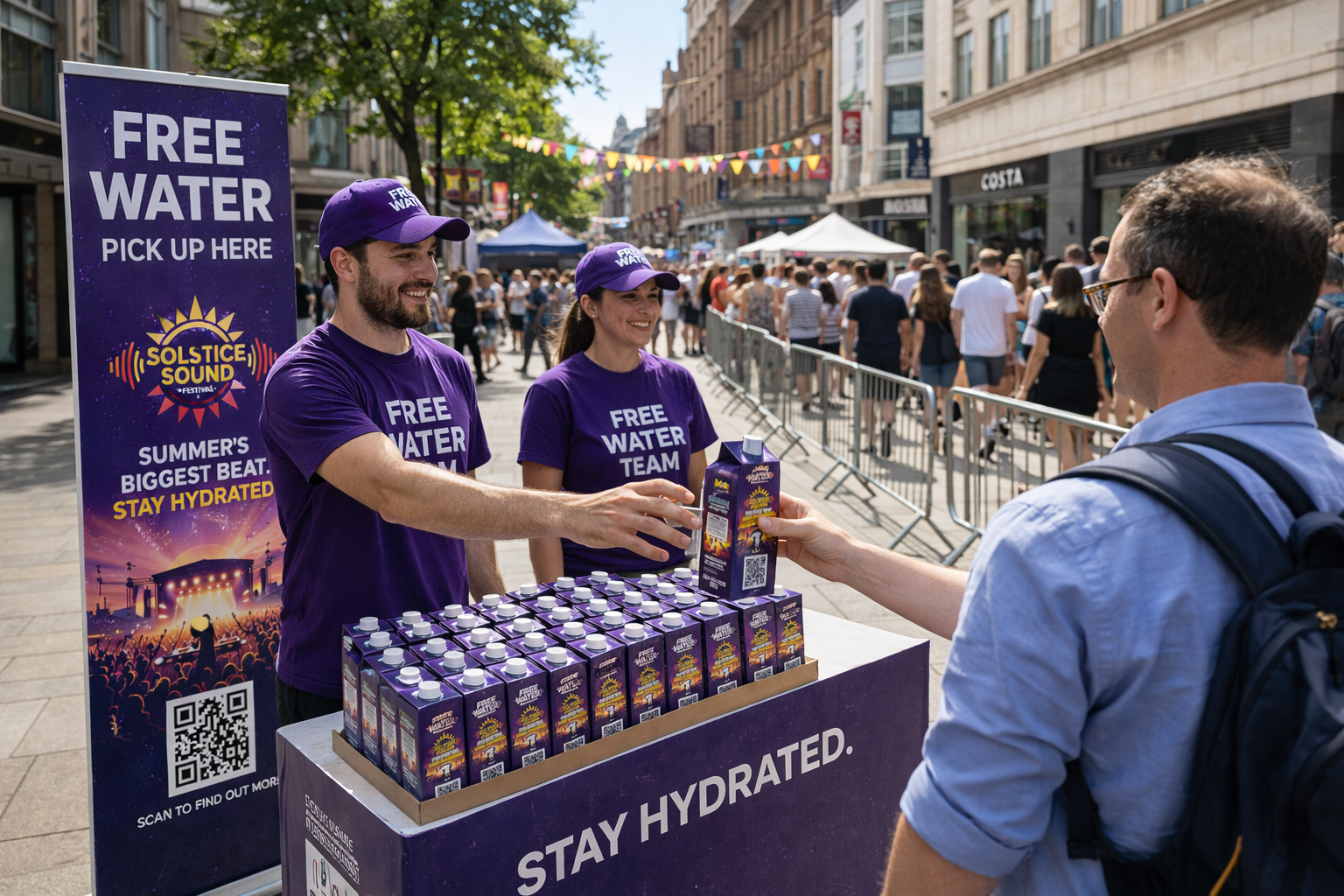
It is a sponsor-funded, daytime activation format that works best where a host already has organised public movement and a clear reason water would be welcome. That includes events, markets, city-centre promotional pitches, open public squares, arrival-heavy sites, and walk-through environments where people are moving, waiting, or spending time outdoors.
UKHSA says event organisers should ensure an adequate supply of drinking water throughout an event and that on hot days it is advisable to provide free drinking water that is well signposted and safe to drink. That gives hosts a practical reason to think seriously about water without pretending the conversation has to become a civic crusade.
The first host question is not “can we fit it?” but “where does it belong?”
Good hosts think in terms of fit, not only available floor space.
The best placement is usually not the first patch of open ground someone points at. It is the point in the site where water makes sense and the public interaction will feel natural. That often means:
arrival areas,
registration points,
queuing zones,
market edges,
entry corridors,
welcome hubs,
or central pedestrian flows that are wide enough to absorb interaction without clogging.
HSE guidance says planning should be proportionate to the scale and risk of the event, and crowd-management guidance specifically warns that stalls and concessions can obstruct movement and lead to congestion. It also says organisers should assess venue suitability, arrival and exit points, and create a crowd-management plan.
That is a useful rule for hosts:
place Freee Water where it helps the site, not where it competes with it.
Hosts need clear responsibilities from the start
One reason temporary activations go wrong is shared responsibility with no actual ownership.
HSE says where control of a site is shared, responsibilities should be clearly defined and assigned, with effective liaison on health and safety matters. That matters directly here. A host, operator, sponsor, and venue team all need to know who is responsible for:
site approval,
risk assessment,
staffing,
stock handling,
waste,
signage,
insurance,
and on-the-day problem solving.
This is not bureaucracy for its own sake. It is what separates a smooth activation from a sloppy one.
A good host brief should make those responsibilities obvious before anyone turns up with cartons.
Hosts should expect basic operational documentation
In more formal public-space environments, documentation is not optional theatre.
City of London’s event application asks for a proposed layout, estimated attendance, publicity details, sponsorship information, and public liability insurance. Leeds’ event-spaces policy lists conditions covering site protocol, health and safety, access and egress, vehicles, insurance, noise, filming, and other operational matters.
That means hosts should expect a proper activation to arrive with more than good intentions.
At minimum, the host should want:
a clear site plan,
an agreed activation footprint,
staffing numbers,
waste-handling arrangements,
sponsor and branding details,
and proof that the setup has been thought through.
If the proposal is vague, it is usually because the operator is vague.
Good hosting keeps the activation visually light
Freee Water works best when it looks tidy, mobile, and useful.
Westminster’s public-realm guidance warns against signs and structures that obstruct pedestrians or clutter desire lines. Leeds’ promotional-space policy also makes clear that city-centre promotions must comply with conditions of use and partner-agency requirements.
For hosts, this translates into a simple standard:
no clutter,
no unnecessary structures,
no blocking lines of movement,
no overbranding that makes the setup look like a cheap sales ambush.
The public should be able to understand the activation in seconds and move around it easily.
Hosts should think about timing as much as location
The right location at the wrong time can still underperform.
Hosts should think about when the public actually feels the value of water. That often means:
arrival windows,
lunch peaks,
registration periods,
pre-event queuing,
midday public footfall,
or the moments between major programme points.
Water is not only a placement decision. It is a timing decision.
That is especially important in markets and city-centre sites where the flow of the day changes meaningfully across hours. A host that understands those rhythms can make Freee Water look much more integrated and much less bolted on.
What good hosting looks like in practice
A strong Freee Water host setup usually has these traits:
The site is approved.
The footprint is clear.
The staff know their role.
The public can move easily.
The sponsor looks visible but not overbearing.
And the activation feels like part of the day rather than a random interruption.
That is the standard.
Freee Water should not feel like a favour the site is doing for a promoter. It should feel like a practical sponsor-funded feature of the environment.
The host’s real job
The host’s job is not to solve national hydration policy with one activation. Thankfully.
The host’s job is simpler:
choose the right spot,
define the responsibilities,
keep the site safe and tidy,
and let the sponsor-funded water offer work in a way that improves the day.
That is exactly where Freee Water is strongest.
Not civic theatre.
Not charity theatre.
Just clear operations, clear value, and a public-facing format that makes sense.