Freee Water vs Branded Water Bottles: What Actually Performs Better?
// NO DESCRIPTION DATA
This comparison only makes sense if you define the job first
A lot of marketers compare formats badly.
They ask, “Which performs better?” without first deciding what performance means.
That is how people end up arguing about apples, wrenches, and dead campaign ideas as if they all belong in the same basket.
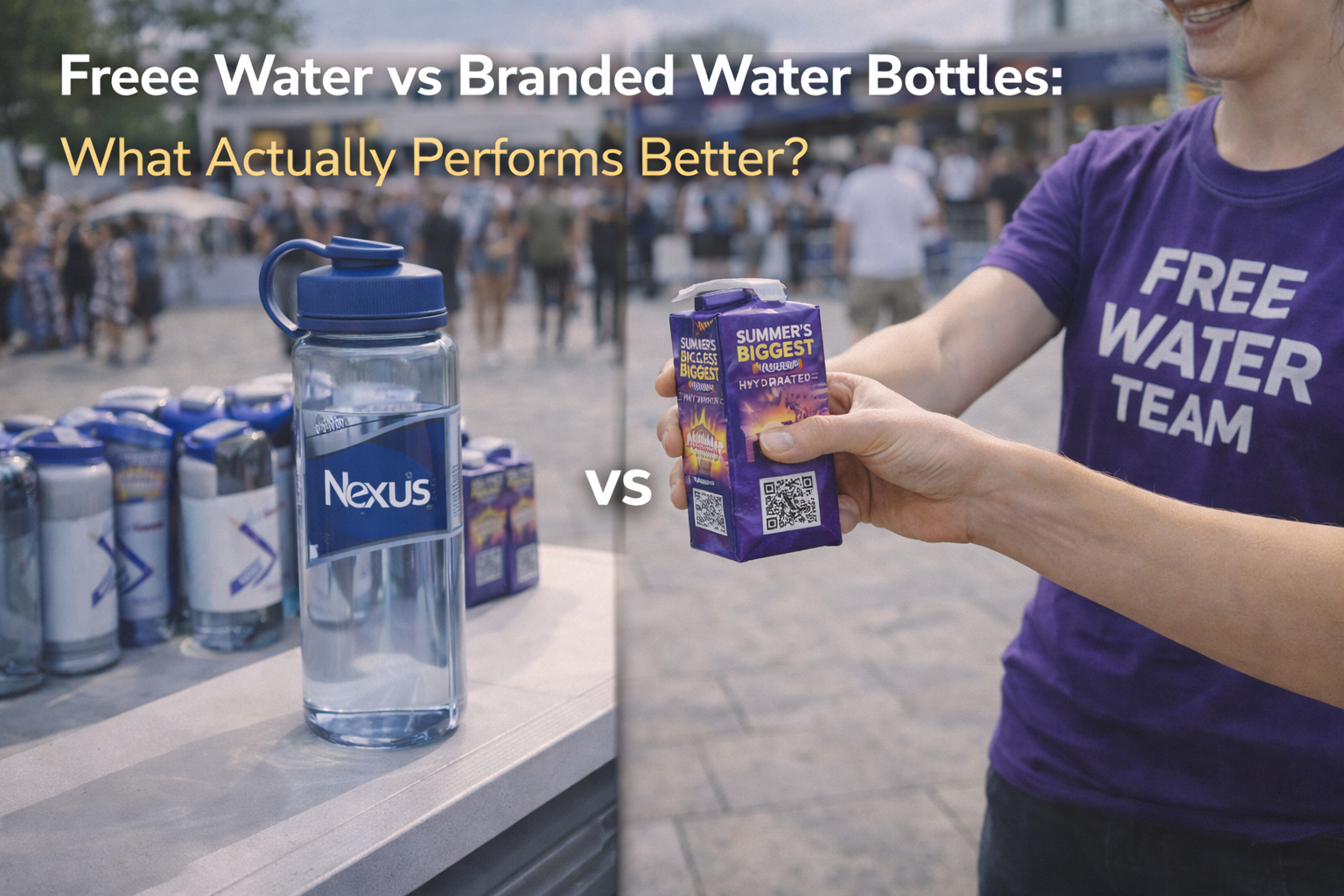
Branded water bottles and Freee Water do not always do the same job.
A branded reusable bottle is usually a merchandise item. It is designed to be kept, reused, and associated with the brand over time.
Freee Water is a live distribution format. It is designed to be used immediately in a selected environment, with the brand message attached at the exact moment of need.
So the right question is not “Which is universally better?”
The right question is “Which is better for this objective?”
If you want long-tail merchandise presence, a reusable bottle may make more sense.
If you want immediate utility, easy uptake, and public-facing activation in a city centre or event setting, Freee Water often makes more sense.
Branded bottles are future-use media
A branded bottle depends on later behaviour.
The person has to keep it.
Carry it.
Clean it.
Use it again.
See the brand enough times for the object to build memory.
That can work. In the right context, it works very well. Conference gifting, employee kits, internal culture packs, premium event bags, sports sign-ups, and selective merch drops are all examples where a branded bottle can be perfectly sensible.
But it is still a future-use object.
Its value is not fully delivered at the moment of handover. It asks the recipient to complete the format later.
That is where Freee Water has a major advantage in public-facing campaigns.
Freee Water is present-use media.
The utility is not delayed.
The exchange is complete in the same moment the brand is seen.
Freee Water is immediate-use media
That difference matters more than most campaign decks admit.
In a city-centre or event environment, people are already moving. They are not always in the mood to accept another object that adds friction to the day. A reusable bottle, however well branded, can still feel like “something else to carry.”
Freee Water avoids that problem because the use case is immediate. The person gets hydration now, not at some hypothetical future point when they remember the bottle exists.
That immediate utility aligns very well with UK event and public-space expectations. UKHSA guidance for mass gatherings says organisers should ensure an adequate supply of drinking water and that on hot days it is advisable to provide free drinking water. London’s public water strategy has focused heavily on refill points and reusable bottles, which shows the cultural direction of travel, but it also highlights the gap Freee Water fills: not everyone already has a bottle with them, and not every brand campaign needs a fixed refill asset.
That is why Freee Water should not be seen as a weaker bottle. It is a different mechanism.
Which format is easier to accept in public?
In moving public environments, ease matters.
A branded bottle asks for more from the recipient.
It takes space.
It adds weight.
It may feel useful later rather than now.
And if the person already has a bottle, it can become redundant.
Freee Water asks for less.
Take it.
Drink it.
Keep moving.
That simplicity makes it better suited to city centres, queues, event entry points, open days, and short-contact activations where acceptance rates live or die on whether the public can understand the offer instantly.
This is one of the quiet strengths of the format. It does not try to manufacture attachment through permanence. It earns attention through timing.
What about branding lifespan?
This is where branded bottles fight back.
A reusable bottle can stay with someone for weeks, months, or longer. If the item is attractive and genuinely useful, the brand may gain repeated exposure over time. That is real value.
But marketers often inflate that value by assuming every branded bottle becomes a cherished life companion rather than one more object in a cupboard full of branded optimism and stale conference trauma.
The truth is more practical.
Some branded bottles are kept and reused.
Some are forgotten.
Some are regifted.
Some are binned faster than anyone wants to admit.
So yes, branded bottles can offer longer brand life.
But they depend on the recipient choosing to continue the relationship.
Freee Water offers shorter lifespan but more guaranteed immediate relevance.
That makes it better for campaigns where the goal is activation, visibility, and welcome utility rather than long-term merchandise retention.
What performs better at events and city centres?
In most live public-facing settings, Freee Water has stronger campaign fit.
Why?
Because those environments reward clarity, movement, and low-friction interaction.
An event guest arriving in a queue does not necessarily want another object to carry around all day. A pedestrian in a city centre may not want merch at all. But a free branded water carton in the right moment is easy to understand and easy to accept.
That is especially true in daytime environments where the campaign is designed around practical usefulness, not novelty theatre.
Branded bottles are more selective. They tend to perform best when there is already a relationship with the audience, a bag to put them in, or a reason for the item to remain with the person beyond the event itself.
So again, the answer is not universal. But in the specific lane Freee Water wants to own, city centres and daytime events, the mobile, immediate-use model is often a better fit.
The sustainability and model difference
There is another reason these formats should not be treated as interchangeable.
A branded bottle is usually a product unit.
Freee Water is usually a campaign unit.
That changes how the brand story works.
With a bottle, the brand is gifting or distributing a durable object.
With Freee Water, the brand is funding access in the moment.
That can create a stronger public story because the sponsor is not simply giving away stuff. The sponsor is making something available where it is needed.
That does not make one morally superior by magic. It just makes the storytelling cleaner.
And for Freee Water specifically, that distinction helps keep the business in the right lane:
not a refill-point provider,
not a merchandise supplier,
not a charity,
but a sponsor-funded public activation model.
So what actually performs better?
Here is the honest answer.
Branded water bottles perform better when the goal is long-term merchandise, retained use, or a more premium branded object.
Freee Water performs better when the goal is immediate utility, public-facing interaction, city-centre/event take-up, and a cleaner sponsorship story.
That is the real split.
For the environments Freee Water is built for, daytime public activations, events, queues, open spaces, and city-centre placements, the immediate-use model is usually the stronger performer.
Not because bottles are bad.
Because the job is different.
And good marketing starts by admitting that before wasting money pretending one format can do everything.