Freee Water vs Promotional Flyers: Which Gets Real Attention?
// NO DESCRIPTION DATA
Flyers are cheap for a reason
Promotional flyers survive in marketing because they are easy to produce, easy to brief, and easy to imagine at scale.
That does not mean they are easy to make effective.
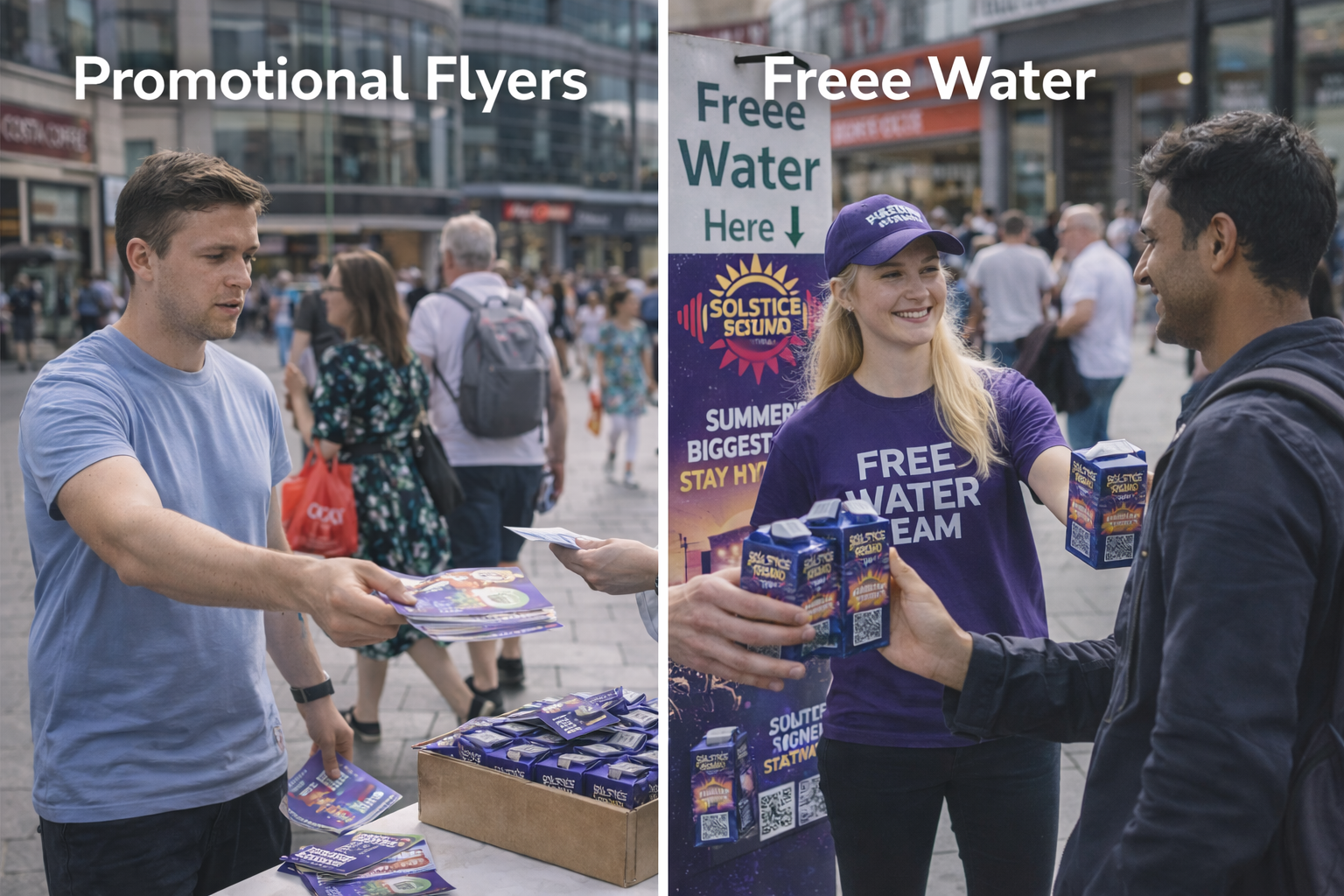
A flyer asks a stranger to pause, accept a piece of paper, decide it is worth keeping, and then act on it later. Every part of that sequence creates drop-off. A lot of the time, the flyer is not really being “read.” It is being tolerated for a few seconds before it becomes pocket clutter, bin fodder, or street litter.
Freee Water works differently because it is useful before the message is processed. A person does not need to be convinced that water is relevant. They understand the value instantly. The brand gets into the interaction without first having to overcome the resistance that most printed promo material creates.
That is not just theory. Councils in England and Wales can require permission for distributing free printed matter, and free literature controls exist specifically because of the litter problems associated with leaflets and similar material. Doncaster Council states plainly that the legislation exists to control litter created by free printed matter that is often quickly discarded, while GOV.UK notes that councils may require permission and fees for distributing leaflets in designated areas.
The problem with interrupted attention
A flyer is an interruption-first format.
That means the first emotional response is often defensive.
The recipient is thinking:
What is this?
Do I need it?
How long is this going to take?
Where am I supposed to put it?
Am I now responsible for not looking rude?
That is a terrible opening position for a brand.
Freee Water starts from a much cleaner place. The person sees something they understand. The interaction can happen in seconds. The item solves a real need or at least feels welcome enough to accept. The brand message enters on the back of that usefulness.
That matters because “attention” is not one thing.
There is forced attention.
There is passing attention.
And there is receptive attention.
Flyers often achieve the first.
Freee Water has a better chance of achieving the third.
Flyers also create operational friction
This is the part marketers love to ignore because it is less fun than moodboards.
In some places, flyer distribution is not merely a creative choice. It is a regulated activity. Leeds city-centre event spaces list leaflet distribution among their conditions of use. GOV.UK notes that councils can place conditions on what, when, where, or how leaflets are distributed. Doncaster lists fines, fixed penalties, and consent requirements in designated places. None of this means flyers are impossible. It means they are not the frictionless default people pretend they are.
And even when they are allowed, someone still has to carry them, distribute them, and deal with the fact that a percentage will end up discarded.
That matters for brand perception too.
A flyer can easily become part of the visual mess around a city-centre promotion. A useful handout is far less likely to feel like waste at the moment of exchange.
Why water gets accepted more naturally
A flyer depends on persuasion.
Water depends on relevance.
That is the real split.
When a brand team hands out free water in a city-centre or event environment, the exchange feels less like an ask and more like an offer. The public does not need to imagine future value. The value is present already.
That changes three things at once.
First, acceptance is easier.
Second, the brand enters the interaction with less resistance.
Third, the recipient is more likely to carry the branding through the environment because the item is still being used.
A flyer often has to survive long enough to be read.
Water only has to survive long enough to be welcomed.
That is a much better starting point.
But flyers are not always useless
This is where lazy comparisons go wrong.
Flyers are not worthless in every case. If the goal is to communicate specific information, map routes, list offers, push a short-term code, or direct people somewhere nearby, a flyer can still do a job. There are campaigns where a printed takeaway item is exactly what is needed.
But that is not the same as saying it is the best format for public-facing brand goodwill or attention.
If your objective is practical visibility, warmer brand association, and better take-up in a moving crowd, Freee Water has structural advantages.
If your objective is dense information transfer, a flyer may still help.
The point is not to kill one format out of spite. The point is to stop pretending both formats ask the same thing of the audience.
They do not.
Freee Water creates attention without creating paper fatigue
One of the quiet problems with flyer culture is saturation.
People in busy urban environments already expect paper promotion to be low-value by default. They have learned to reject it before it reaches their hand. The format carries baggage.
Water does not carry the same baggage.
It has a practical use case.
It feels timely.
It does not need explaining.
And it does not trigger the same “I’m being sold to” reflex in the first second.
That does not mean every person will accept it. It means the format begins with less suspicion.
For brands, that is huge.
Because the hardest part of physical promotion is not often the branding itself. It is earning the right to enter the person’s space without annoyance.
Which gets real attention?
If by “attention” you mean someone technically saw the thing for half a second, flyers can still generate plenty of it.
If by “attention” you mean someone willingly accepted the item, registered the brand in a useful moment, and carried that interaction forward in public, Freee Water is stronger.
That is especially true in the exact environments where Freee Water is supposed to operate:
- daytime city centres
- queues
- event entry points
- open days
- warm-weather footfall areas
- family-friendly public spaces
- commercial activations where usefulness can be seen
These are not ideal flyer conditions. They are utility conditions.
The commercial verdict
Flyers are still a tool.
But too often they are used because they are familiar, not because they are best.
Freee Water offers something a flyer rarely can:
a low-friction exchange where the public gets something useful, the brand becomes part of that usefulness, and the environment does not feel more cluttered as a result.
That is why it gets better attention.
Not louder attention.
Not more desperate attention.
Better attention.
For brands trying to make a real impression in physical public spaces, that difference is the whole game.