
From City Centre to Event Site: How Freee Water Fits Live Campaigns
// NO DESCRIPTION DATA
Live campaigns need formats that travel well between environments
A lot of brand activations are built for one setting only.
They work on a stand.
Or in a queue.
Or at an event.
Or in a city-centre pitch.
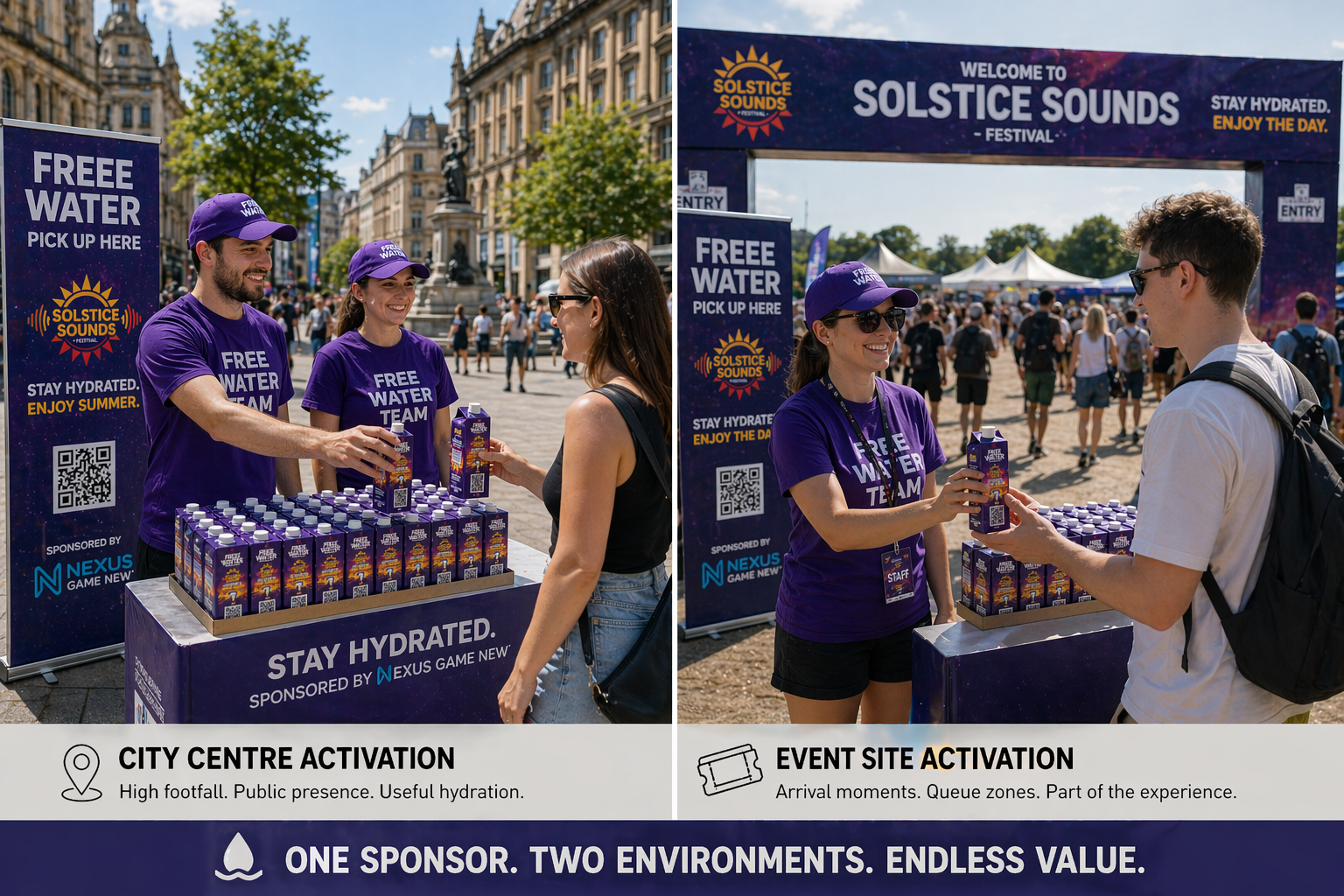
That can be fine, but it limits campaign flexibility. One of the strengths of Freee Water is that it can work across more than one live environment without losing the logic of the format. That is useful because brands do not always want to choose between city-centre presence and event-site relevance. Sometimes they want a model that can move between both.
That is exactly where Freee Water fits live campaigns well.
City centres and event sites share one important trait
They are both movement environments.
People arrive, pass through, wait, gather, disperse, and make fast decisions. That is why the same core strength matters in both places: usefulness at the point of movement.
ONS still tracks town and city-centre footfall as a major retail indicator, while Leeds continues to market city-centre promotional and event spaces in high-footfall areas with structured booking rules. On the event side, UKHSA still frames drinking water as part of proper event planning.
Put those together and the commercial pattern becomes obvious:
Freee Water can operate in both city-centre and event settings because both reward visible, useful, low-friction interactions.
In the city centre, the format works as a public-facing activation
In a city-centre setting, Freee Water behaves like a sponsor-funded public activation.
The goal is usually broad visibility, practical interaction, and relevance inside a high-footfall environment. The public is not there for the activation specifically, so the format has to earn its place quickly. That is why city-centre Freee Water works best where the usefulness is immediate and the public does not need convincing.
Strong city-centre use cases include:
- pedestrianised shopping routes
- public squares
- lunchtime commuter periods
- market-adjacent pitches
- managed promotional spaces
- event spillover areas
The sponsor gets a live public presence.
The public gets water without friction.
The campaign feels like a useful interruption rather than a pointless one.
At the event site, the format works as an experience enhancer
At an event site, the same format takes on a slightly different role.
The public is already inside a planned environment. There are entry points, queues, registration flows, welcome zones, and programmed movement. That means Freee Water can fit more directly into the rhythm of the day.
It works especially well at:
- arrival points
- registration desks
- event entry queues
- welcome areas
- route transition points
- family activity zones
- sports participation environments
In these placements, the sponsor is not only visible. The sponsor becomes part of how the day begins or flows.
That is a stronger role than a static sponsor asset usually gets.
The value is in the continuity
This is the important part.
A campaign format that works in both city-centre and event environments gives a sponsor more continuity. It allows one core idea to travel across multiple live settings without becoming a completely different product each time.
That matters for brand consistency.
It matters for campaign reporting.
And it matters for hosts and operators who want a format that is easy to understand in different contexts.
The city-centre version says:
here is a useful public-facing activation.
The event version says:
here is a useful part of the live experience.
Same model.
Different environment.
Still coherent.
It also helps separate Freee Water from refill infrastructure
London’s public water strategy remains strongly associated with fountains and refill stations, which is useful context because it shows how often “free water” gets reduced to fixed infrastructure in the UK conversation.
Freee Water is different.
It is not trying to be a permanent fountain network.
It is not a refill map.
It is not a static utility layer.
It is a mobile sponsor-funded format designed for live campaign environments. That is exactly why it can move from city centre to event site without losing relevance.
If the model were built around fixed infrastructure first, that flexibility would be much weaker.
Why sponsors should care
UK Regulatory & Legal Framework for Public Water Access
Public hydration access across the United Kingdom operates within a fragmented statutory environment. Under The Licensing Act 2003 (Mandatory Licensing Conditions) Order 2014, licensed on-trade premises such as pubs, bars, and restaurants are legally required to provide free potable tap water to customers where reasonably available. However, because this legal mandate applies exclusively to paying or recognized patrons, it inadvertently establishes an exclusionary “pay-to-function” commercial barrier for the broader public navigating high streets, public transport corridors, and town centres.
According to nationwide behavioral data published by Refill UK and the City to Sea campaign, over 71% of UK consumers feel acute psychological stigma and social hesitation when requesting free tap water in commercial venues without making a purchase. Furthermore, under the Water Industry Act 1991 (Sections 181 and 182) and guidance from the Drinking Water Inspectorate (DWI), municipal local authorities bear no statutory duty to install or maintain public outdoor drinking fountains. Faced with severe budgetary deficits, local councils frequently decommission municipal water fountains due to winter freezing liabilities, pipework deterioration, legionella testing requirements, and anti-social behavior risks.
Hydration Channel & Economic Footfall Comparison
To examine why conventional public infrastructure struggles to provide reliable, stigma-free hydration across UK urban centres, we compare the primary access channels across physical accessibility, consumer friction, and municipal maintenance:
| Hydration Channel | Accessibility / Cost | Stigma Level | Maintenance Burden |
|---|---|---|---|
| Commercial Venues (Cafes/Pubs) | “Pay-to-function” barrier (£2.50–£4.50 purchase barrier) | High (71% social hesitation) | Low (Customer-funded hospitality staff) |
| Municipal Fountains | Free, but high freeze, lead-pipe & vandalism risk | Low | High Council Maintenance & Winter Shutdowns |
| FreeeWater Faith / Community Mesh | 100% Free, Heated, Staffed & Welcoming | Zero Stigma (Open-Door Civic Hospitality) | Community-Partnered & Sponsor-Funded |
Civic Infrastructure Topology & Community Mesh Flow
The FreeeWater community mesh leverages existing civic architecture, faith institutions, municipal libraries, and community hubs to distribute free hydration with zero taxpayer expenditure. By situating sustainable paper-carton dispensers directly inside community warm spaces, the network solves both physical access constraints and social stigma.
[ Local Resident / Passerby ] ──► [ Faith / Community Hub ] ──► [ FreeeWater Dispenser ]
                                         │                              │
                                         ▼                              ▼
                              [ Warm Space & Dignity ]      [ Zero Plastic Waste ]
Operational Lifecycle & Verified Environmental Impact
Civic hydration initiatives often falter during operational scaling due to plumbing maintenance overheads and regulatory water safety compliance. When traditional outdoor fountains freeze or become contaminated, local councils face months of procurement delays. The FreeeWater ecosystem bypasses centralized utility gridlocks by supplying pre-packaged, hermetically sealed paperboard cartons directly to verified distribution hubs.
Every FreeeWater unit is packaged in FSC-certified paperboard laminated with a thin plant-based barrier, generating 64% fewer greenhouse gas emissions across its lifecycle than standard virgin PET bottles. Ethical brand partners sponsor the outer packaging canvas, turning essential public utility into a high-recall communication channel. In turn, 10p from every distributed carton is transferred directly to the Feed and Flow Foundation to build permanent clean water infrastructure globally.
Oliver Green
Verified AuthorLead Technical Writer & Civic Hydration Specialist • FreeeWater Impact Research
Lead technical writer and community infrastructure analyst at FreeeWater. Researching civic hydration accessibility, UK water regulatory policy, circular packaging lifecycle analysis, and community-driven utility models.
Explore Related Hydration Dispatches
Continue reading connected technical guides and community case studies.

Why Useful Sponsorship Beats Another Banner
A lot of sponsorship is visible and forgettable That is the problem in one sentence. Traditional sponsorship a...
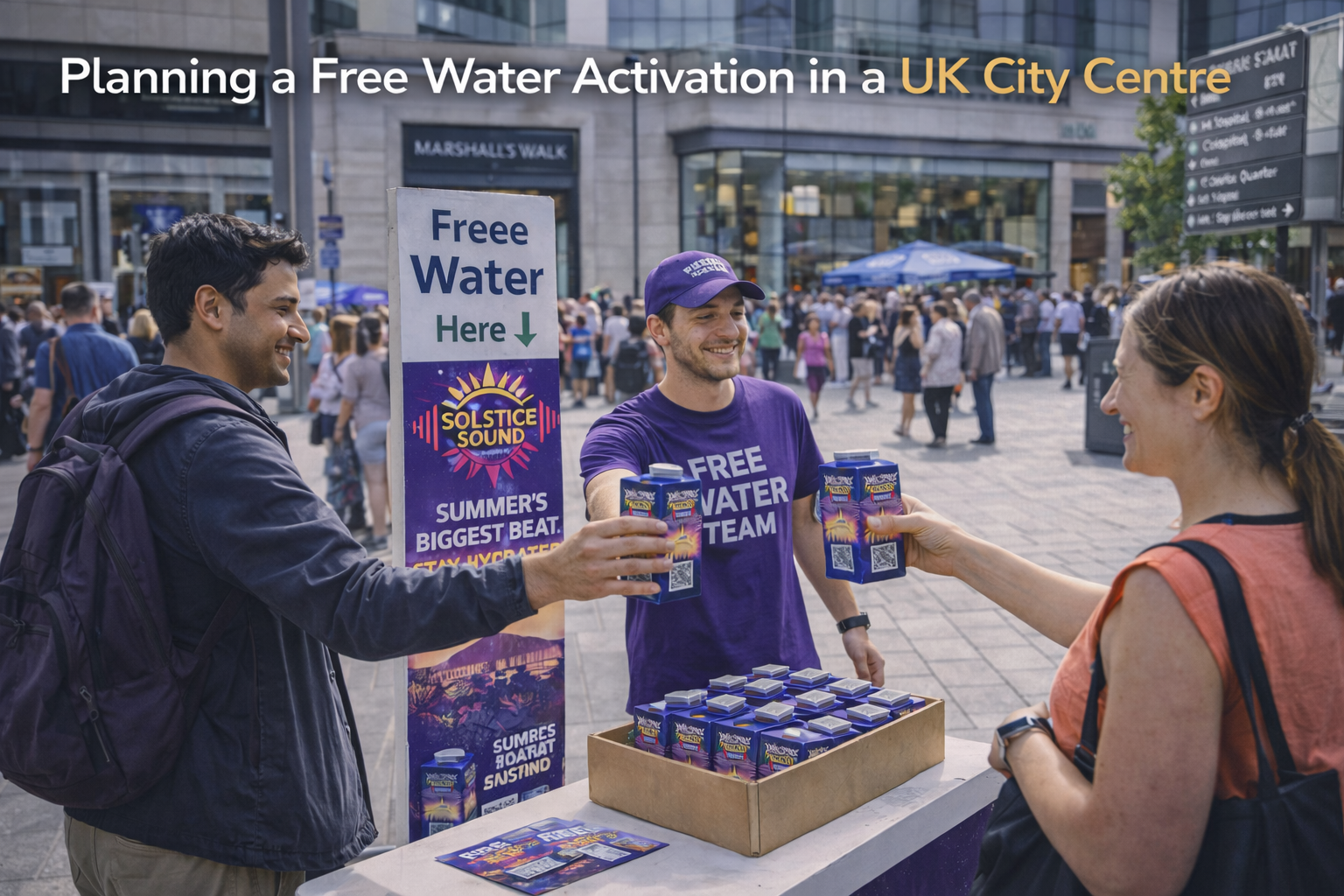
Planning a Free Water Activation in a UK City Centre
A city-centre activation starts with the site, not the carton Too many brand activations start with the visual...
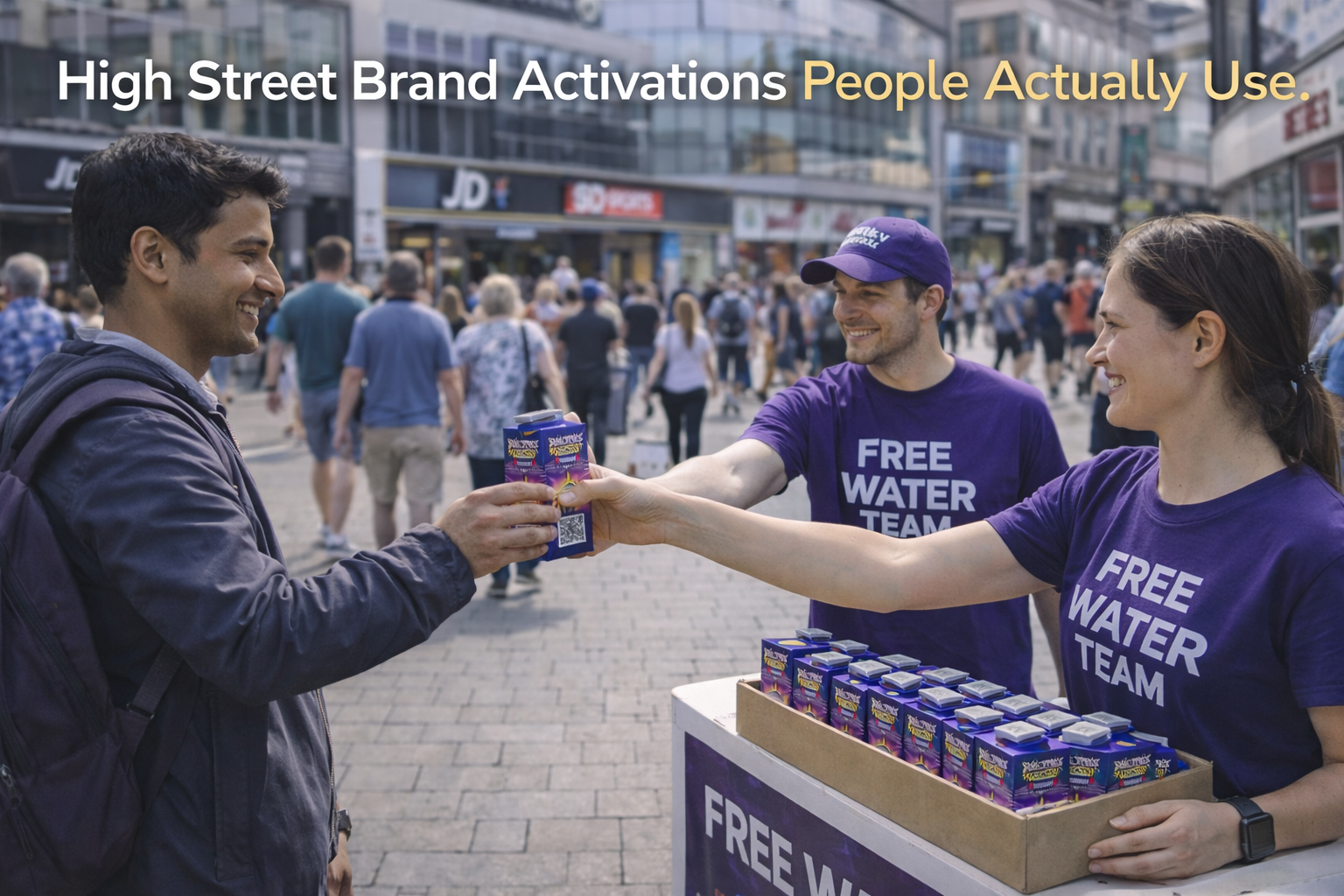
High Street Brand Activations People Actually Use
The high street does not need more noise The high street is already full of things asking for attention. Shop ...