From Pilot To Network: How Freee Water Could Grow Across A City
// NO DESCRIPTION DATA
Free Water
It is one thing to put a single stand of free water on a busy street.
It is another to build a reliable network across a whole city.
Freee Water CIC is built to move from pilots to wider coverage in a way that is:
- Data informed
- Operationally realistic
- Transparent about what is working and what is not
This matters for councils, brands and residents who want more than a one day photo opportunity.
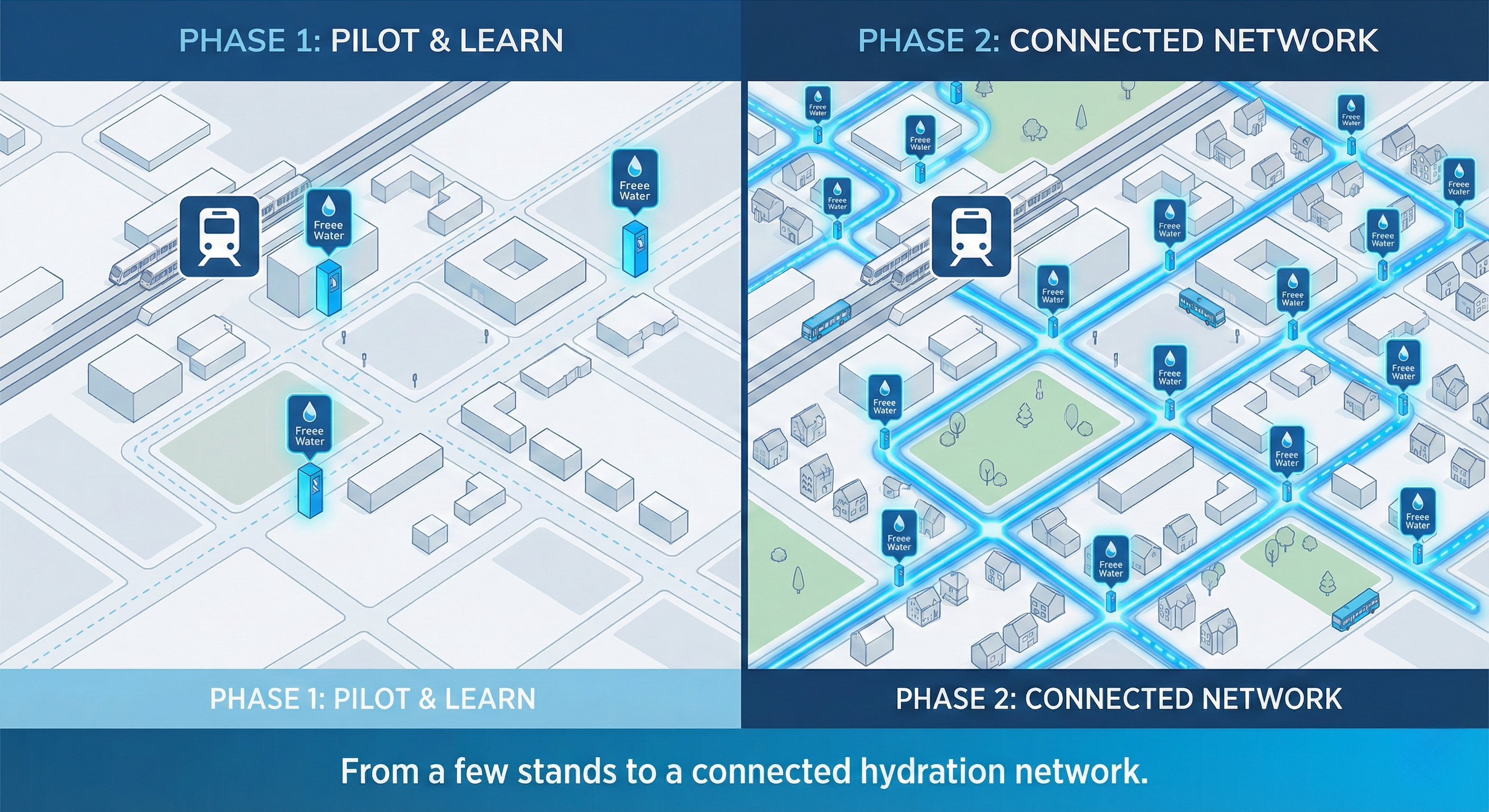
Start small, learn honestly
Every city is different. Footfall patterns, transport links, retail mix, climate exposure and existing infrastructure all vary.
Freee Water expects to begin with:
- A small number of pilot locations in one city or region
- Clear criteria for site selection, such as footfall, local need and host support
- Simple measures of success, including litres distributed, peak times of use and user feedback
Rather than promise a full map on day one, the aim is to learn how Freee Water behaves in the real world:
- Do people understand it quickly?
- Do stands work better near stations, campuses or parks?
- How often should they be restocked?
- What maintenance and security issues actually arise?
This learning phase is a feature, not a flaw.
Building a network, not a scatter of points
Once pilots prove the basics, the next step is to think like a transport planner, not a vending supplier.
A hydration network should:
- Cover key movement corridors, not just isolated spots
- Allow people to access water at multiple points during a typical day
- Balance central locations with neighbourhood level access
In practice, that might look like:
- A ring of stands near major stations and interchanges
- Additional points near colleges, civic buildings and busy squares
- Targeted stands in areas identified by councils and community partners as high need
The goal is coverage that feels coherent when you walk the city, rather than a random scatter.
Matching brand interest with real need
Freee Water is funded by brands that pay to place adverts on cartons and bottles. Scaling across a city means aligning three things:
- Places where residents and workers most need free water
- Locations where brands see value in visibility
- Sites that are practical to host and service
To manage this, Freee Water can:
- Offer different tiers of visibility for brands, across central and local sites
- Blend national campaigns with local sponsors
- Use surplus from high value locations to help support lower income areas
This keeps the network balanced rather than purely driven by commercial hotspots.
Keeping community benefit at the centre
As a Community Interest Company, Freee Water is required to operate for community benefit. In practice, that means:
- Publishing clear information on how many stands are active and where
- Sharing data on litres distributed and patterns of use
- Explaining how surplus income supports food projects through Feed & Flow Foundation
- Being open about limitations, such as capacity during extreme weather
City residents should be able to see the link between brand funded water, free access in their area and support for those facing food insecurity.
What success could look like
In a mature city network, a resident might:
- Grab a Freee Water carton near their local bus stop
- See another stand when changing at a central station
- Refill a reusable bottle at work
- Pick up free water again near a park on the way home
At no point would they have to make a decision between hydration and another basic cost.
For councils and partners, success would show up as:
- Fewer emergency issues related to dehydration in heatwaves
- Reduced plastic bottle litter in key areas
- Visible, understandable infrastructure that residents value
- A steady stream of support flowing into food projects through Feed & Flow
Freee Water will not turn a city into a utopia. It can, with careful planning and honest reporting, make one essential part of daily life less fragile.
Networked free water on the street is not a luxury. It is the kind of baseline that a wealthy country should be able to provide.