Green Claims Are Easy. Useful Sponsorship Is Harder To Fake
// NO DESCRIPTION DATA
Green messaging is everywhere now
Every brand wants to look responsible.
The websites are full of soft green colours.
The packaging says “better for the planet.”
The campaign deck says “purpose-led.”
The LinkedIn post says “proud to support sustainable futures.”
Lovely.
But the public is getting better at spotting the difference between a useful action and a nice-looking sentence.
That is the problem with green marketing. Claims are easy. Real-world proof is harder.
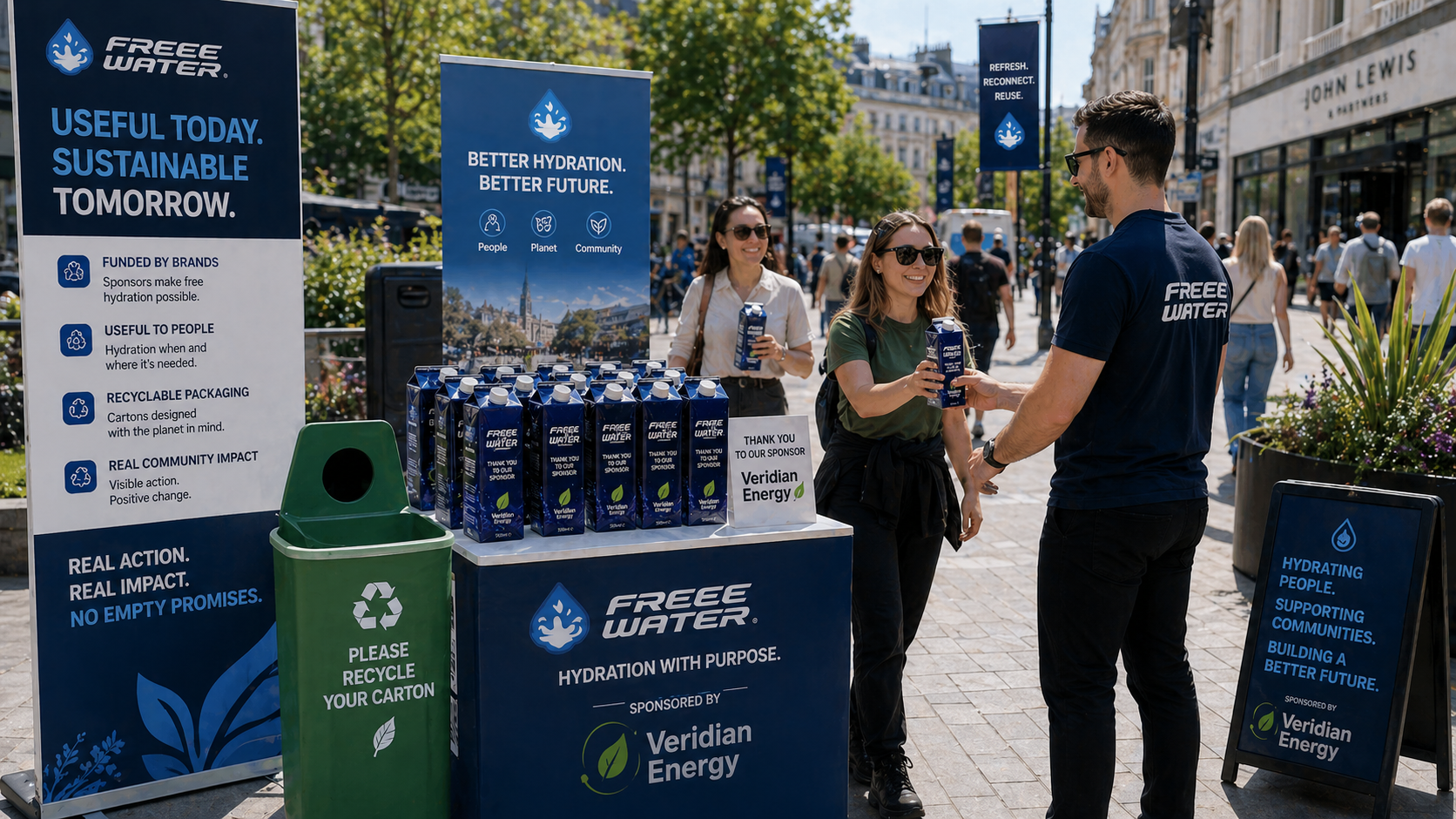
Freee Water gives brands a more practical route: fund something people can actually use, distribute it in real places, and connect the brand to a useful public outcome.
Not another vague promise. An actual campaign.
People trust action more than language
A sponsor does not need to over-explain itself when the action is visible.
If a company funds free drinking water in a city centre, at an event, outside a venue, or in a high-footfall public space, people understand the value quickly.
The brand helped make water free in that moment.
That is simple.
And simple is powerful because it does not need a ten-point manifesto to land.
The public can see the sponsor’s role. The brand paid for the cartons. Freee Water handled the distribution. People received water at no cost.
That is a stronger reputation signal than another “we care” statement buried on a corporate page nobody reads unless legally forced.
Sustainability needs to be practical
A green campaign should not only look clean. It should reduce wasteful behaviour.
Freee Water can support that by using recyclable carton packaging and planning distribution properly, so the campaign is not just dumping branded material into public space.
The point is controlled delivery.
Right place.
Right quantity.
Right audience.
Right disposal planning.
Right sponsor message.
That is what separates useful sustainability from marketing theatre.
A badly planned campaign creates clutter.
A properly planned campaign creates value.
Tiny difference. Massive consequence. Humanity keeps needing labels on things, apparently.
Brands get a better story to tell
Companies are under pressure to show social and environmental responsibility.
But many campaigns feel abstract.
Freee Water gives sponsors a story that is easy to explain internally and externally:
We funded free drinking water.
It was distributed in selected daytime public locations.
The cartons carried our brand message.
The packaging was designed with recycling in mind.
The campaign delivered public value, not just advertising space.
That is clean. That is defendable.
It gives marketing teams, CSR teams, local partnerships teams, and leadership something they can all understand.
Useful sponsorship protects the brand
Green claims can backfire when they feel inflated.
People do not like being lectured by brands, especially when the actual campaign does very little.
Freee Water avoids that trap by keeping the promise grounded.
The brand is not claiming to save the planet with one activation.
It is doing something specific:
Helping make drinking water free in a real place.
That kind of campaign is safer because it is practical. It does not need dramatic claims. It only needs to be delivered properly.
Green marketing works better when it becomes useful.
Freee Water gives sponsors a way to support practical hydration, lower-waste packaging choices, and visible public benefit without hiding behind vague language.
A brand can say it cares.
Or it can fund something people actually use.
One gets ignored.
The other gets remembered.