How Brands Can Use Freee Water for Local Market Entry Campaigns
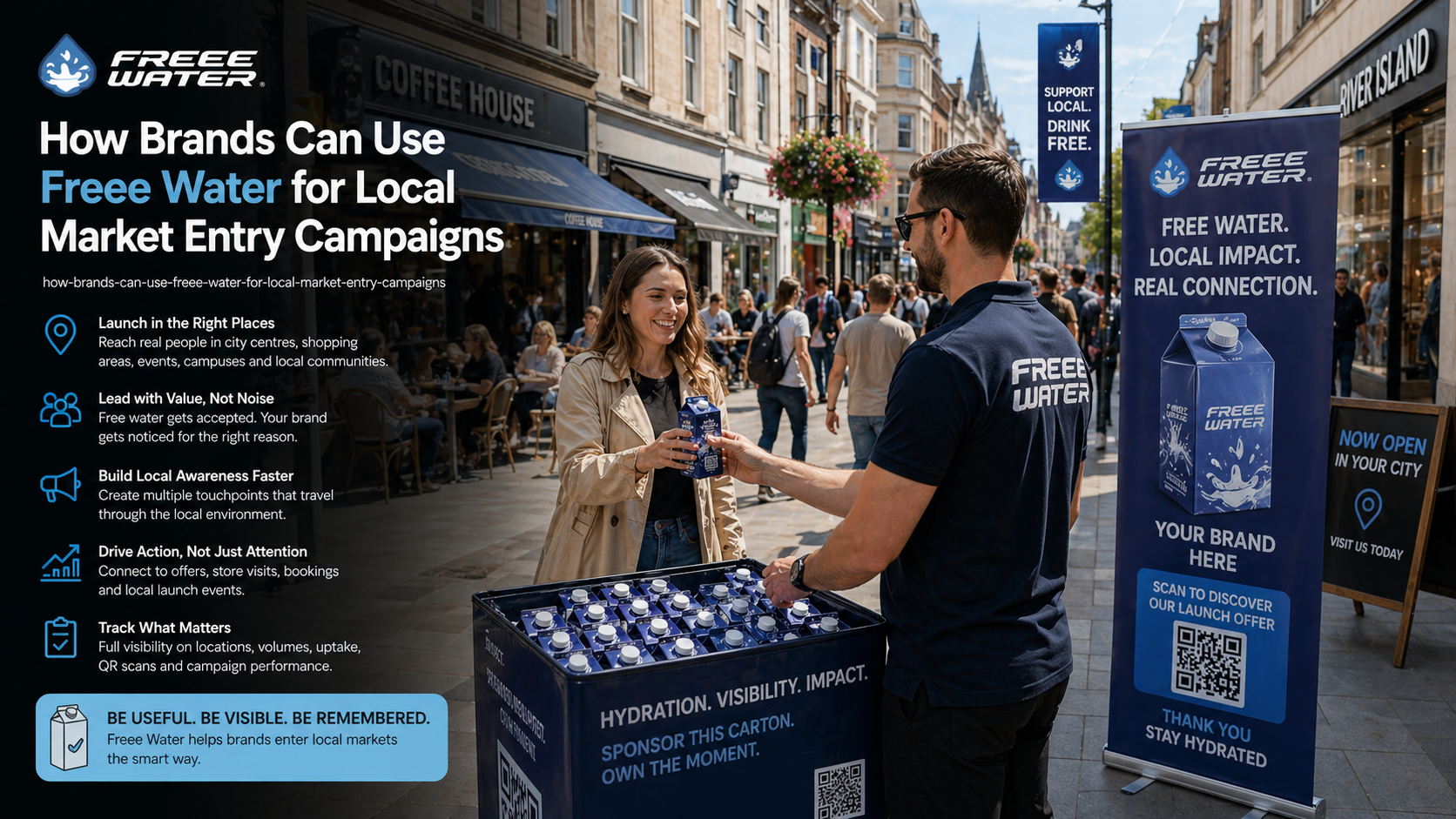
// NO DESCRIPTION DATA
Launching locally is harder than buying attention
A brand can buy impressions anywhere.
That does not mean the market knows it, trusts it, remembers it, or cares.
Local market entry is difficult because the brand has to move from “available” to “recognised.” That shift does not happen from one social campaign or a few posters slapped across a town like marketing confetti.
People need repeated, useful, visible contact.
Freee Water gives brands a way to enter a local market through public value, not just public noise.
Local visibility works best when it feels relevant
A strong local campaign should not feel imported from a boardroom.
It should feel connected to the place.
That is where Freee Water can work well for brands entering a new city, borough, retail zone, campus area, transport corridor, or event-led location.
The campaign can be placed where people already move:
City-centre streets
Shopping centres
Markets
Open days
Commuter zones
High-footfall event areas
Retail parks
Community buildings
Daytime public events
The brand becomes visible in the real geography of the market.
Free water gives the launch a reason to exist
The weakness of many launch campaigns is that they announce themselves without offering anything useful.
“We’re here.”
“Now open.”
“Try us.”
“Scan here.”
Fine. But why should anyone care?
Freee Water changes the entry point.
Instead of leading with a pitch, the brand leads with something useful. That makes the campaign less needy and more welcome.
A sponsored carton can carry the brand message, QR code, campaign line, offer, location prompt, or launch announcement. But the water does the first job: it gets accepted.
That is the whole game.
It helps brands build familiarity faster
Local trust is built through repeated exposure, but exposure has to be clean.
A sponsored water campaign gives a brand multiple contact points:
People see the activation.
They receive the carton.
They notice the sponsor.
They carry it through the area.
Others see it in public.
Some scan or search later.
That creates visibility beyond the first handout.
For a new local brand, that matters because the campaign does not live only at the distribution point. It travels through the environment.
It works for brands with physical locations
Freee Water is especially useful for brands that need people to know where they are.
That includes:
Gyms
Food brands
Local retailers
Clinics
Education providers
Property developments
Transport services
Entertainment venues
Student accommodation
Retail openings
Hospitality groups
The carton can connect the useful moment to the next step.
Visit the store.
Scan the launch offer.
Book a trial.
Find the nearest location.
Join the opening weekend.
Follow the local page.
The CTA can be simple because the campaign already earned attention.
It also works for service brands
Not every brand needs footfall on the same day.
Some need awareness, trust, and memory.
For service brands, Freee Water can work as a local awareness layer. It helps make an invisible service visible in the places where target customers actually move.
A legal firm, health provider, home services company, recruitment brand, education platform, or financial service can use the carton to introduce itself without the awkwardness of cold street selling.
The public interaction stays light. The brand message stays clear.
Local campaigns need proof, not vibes
The beauty of a physical distribution model is that delivery can be tracked.
A brand should be able to see:
Where the campaign ran
How many cartons were distributed
What time windows performed best
Which locations had stronger uptake
How QR engagement performed
What creative version was used
What public response looked like
That gives the marketing team something better than “good energy.”
Good energy is lovely. So is a unicorn with a media budget. Brands need proof.
Freee Water gives brands a smarter way to enter local markets.
It creates visibility without acting like an interruption. It gives the public something useful first. It lets brands attach their name to a positive, practical moment.
For local launches, that is the point.
Do not just announce the brand.
Make the brand useful in the place it wants to grow.