How Freee Water Works for Brands in UK City Centres
// NO DESCRIPTION DATA
City centres still matter because people still move through them
A lot of marketing talk swings between two extremes.
One side acts like everything is digital now and physical environments barely matter.
The other side acts like any brand standing in a city centre automatically wins.
Both are lazy.
The real answer is that city centres still matter when the format fits the environment. ONS retail footfall data showed that UK town and city centre footfall was broadly unchanged month to month in November 2025 and up 2 percent year on year, while London was the only UK region to show an overall year-on-year increase in retail footfall at 3 percent. That is not a fantasy metric. It is a reminder that city-centre footfall is still commercially relevant when the activation is designed for movement, attention, and utility rather than wishful thinking.
This is exactly where Freee Water makes sense.
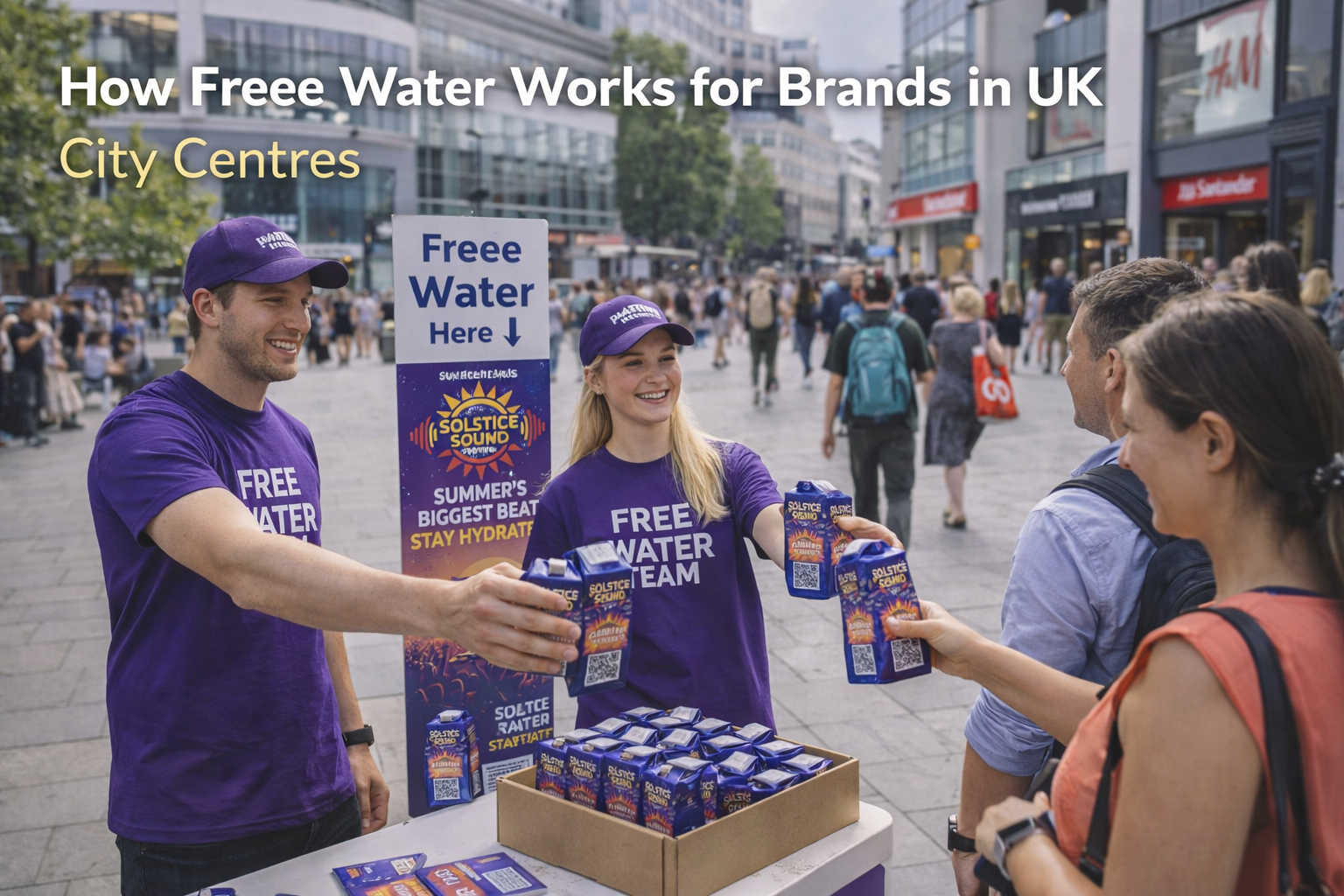
It is not asking a city-centre crowd to stop and admire branding for its own sake. It is offering free drinking water in a place where movement is constant, decision time is short, and usefulness is more persuasive than noise.
What brands are actually buying
Brands are not buying “water” in the narrow sense.
They are buying a public-facing interaction.
They are buying presence in a high-footfall environment.
They are buying physical distribution with a message already attached.
And, if the campaign is designed properly, they are buying something even more valuable than raw visibility: relevance.
In a UK city centre, that matters. People are moving between shops, stations, offices, appointments, universities, lunch spots, civic spaces, and event zones. If a brand appears in that environment with another useless handout, it becomes background irritation. If it appears with something practical, the exchange changes.
Freee Water works because it turns sponsorship into something the public can immediately use.
That means the sponsor is not reduced to a logo floating above a crowd. The sponsor becomes part of a useful moment inside that crowd.
How a city-centre campaign actually comes together
A city-centre Freee Water campaign does not begin with cartons. It begins with the site.
That is the first thing brands often underestimate.
City centres are not blank canvases. They are managed environments with permissions, conditions, landowners, council processes, booking windows, public-safety rules, and operational constraints. Leeds City Council, for example, explicitly offers promotional and event spaces in high-footfall city-centre locations, while also requiring organisers to follow booking procedures, submit supporting documentation, and comply with conditions covering health and safety, access, insurance, noise, leaflet distribution, and other site rules. Westminster’s public event guidance similarly requires a formal application and fee, and City of London notes that highway events can require supporting documents, fees, lead time, and licensing.
That sounds bureaucratic because it is bureaucratic. Cities enjoy turning straightforward things into paperwork marathons.
But commercially, this is good news too.
It means serious city-centre promotion already has structure. You are not wandering into random public space and hoping nobody notices. You are planning a real activation with a real location strategy.
That is where Freee Water becomes stronger, not weaker.
Because once a location is approved, the format itself is easy for the public to understand.
Why the format suits city-centre behaviour
City-centre behaviour is fast.
People do not stand around reading long explanations.
They do not want to be intercepted by strangers asking for too much.
They do not want dead-end “engagement” that gives them nothing.
Freee Water respects that.
The person sees a carton, understands it immediately, and can accept or ignore it in seconds. The brand is present without needing a pitch. The interaction is short but visible. The utility is obvious. The message travels with the item.
That makes the format especially good for:
- commuter-adjacent pedestrian routes
- lunch-hour activations
- shopping corridors
- seasonal city-centre campaigns
- launch days
- public squares
- event spillover zones
- daytime branded roadshows
Unlike a fixed installation, it can be timed and targeted. Unlike a flyer, it is not trying to survive by inertia. Unlike a static billboard, it creates actual handling and immediate use.
Why daytime matters
This is not a small detail. It is central to the model.
Daytime environments are where the Freee Water proposition is cleanest. The audience is broad, the tone is lighter, the placements are easier to justify, and the sponsor association feels practical instead of opportunistic.
That is why city-centre Freee Water should be framed around daytime footfall, open public movement, visible staff presence, and sensible site selection.
Once you start drifting into nightlife language, late-night crowd control, or welfare-adjacent storytelling, you stop sounding like a sharp commercial activation and start sounding like a confused emergency service.
Freee Water works best when it is clearly what it is:
a sponsor-funded, daytime, useful brand presence.
What the brand gets from city-centre placement
A good city-centre campaign gives the sponsor several things at once.
It gives reach, because the environment is high-footfall.
It gives visibility, because the branding sits at hand level and moves with people.
It gives interaction, because the item is physically received.
It gives positive association, because the exchange solves a small problem.
And it gives context, because the brand is seen in a real public setting rather than floating in an abstract media plan.
That combination is stronger than many conventional local activations.
Leeds explicitly markets certain promotional spaces as city-centre opportunities in the highest-footfall locations. That is exactly the type of environment where a utility-led format can outperform generic presence. The point is not that a city-centre activation is automatically magical. The point is that if a council is already offering premium promotional space in those areas, the commercial logic for a useful format is obvious.
How Freee Water fits better than many city-centre handouts
A city-centre activation has to answer one question very quickly:
Why should the public care?
A flyer often struggles to answer that.
A promo card usually fails.
A random branded object depends on novelty.
A static sign depends on traffic and memory.
Freee Water answers the question immediately.
Because it is water.
Because it is free.
Because it is there when the person is already out and moving.
That simple answer is why the format works so well in city-centre settings. It does not need a lecture. It does not need permission from the public to become relevant. It is relevant already.
The best way to think about the offer
Brands should not think about Freee Water in city centres as “sampling but wetter.”
That is shallow thinking.
The better way to see it is this:
Freee Water is a sponsored utility layer inside a live urban environment.
The sponsor is not merely borrowing footfall.
The sponsor is improving the moment moving through that footfall.
That distinction matters because it is what gives the campaign its tone. It feels more welcome, more competent, and more human than a lot of city-centre promotion.
For UK brands trying to show up in public space without acting like visual spam, that is a serious advantage.