How Freee Water Works In Real Life: From Brand Sponsorship To Free Water On The Street
// NO DESCRIPTION DATA
How Freee Water Works In Real Life
Freee Water CIC is built on a simple idea: brands fund the water, people drink it for free.
This post walks through how that actually works in practice, step by step, from the first conversation with a sponsor to someone picking up a free carton on a busy street.
It is the operational side of the story behind Freee Water Community Interest Company and its long term link to Feed & Flow Foundation.
The basic flow in one line
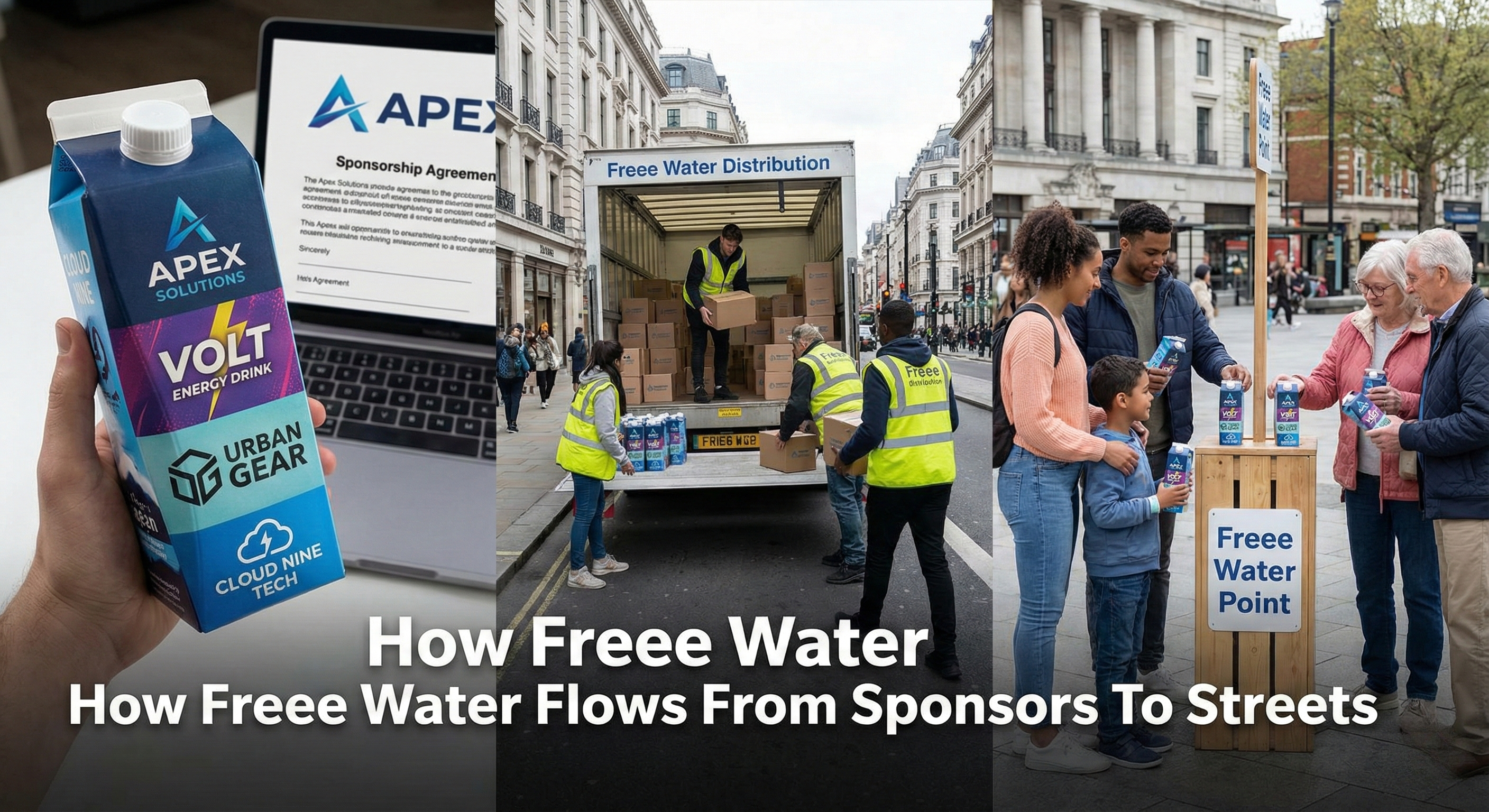
Freee Water CIC secures brand sponsorship, uses that income to produce eco friendly carton water and reusable bottles, distributes them through local partners and volunteers, and shares future surplus with Feed & Flow Foundation to support food projects.
Everything else is detail.
Step 1: Brands back the mission
The starting point is a brand that wants more than screen time.
When a sponsor comes on board, they are not just buying advertising space. They are funding:
- Production of eco friendly carton water
- Logistics and storage
- Real life distribution in UK communities
In return, they receive:
- Their branding on Freee Water cartons or bottles
- A clear, measurable story about how their campaign translates into free water and future food support
- Visibility in locations that matter to people, not just algorithms
Sponsorship agreements are structured so that community benefit and operational costs are protected first.
Step 2: Turning sponsorship into physical stock
Once sponsorship is confirmed, design and production begin.
Carton water
- Cartons are specified for recyclability and responsible materials
- Artwork includes the sponsor message, Freee Water CIC identity and clear call to action via QR code or link
- Runs are planned to fit storage space, distribution plans and expected demand
Reusable metal bottles
- Designed as a longer term option for refill models and events
- Provide a more premium format for certain partners and campaigns
- Help reduce single use waste over time
Every unit is treated as both a hydration point and a small billboard for the model.
Step 3: Storage, logistics and planning
Freee Water CIC uses a social enterprise approach to logistics:
- Stock is held in central storage with simple, trackable inventory
- Deliveries are planned around high need and high footfall locations
- Early runs focus on London and then expand as capacity and partnerships grow
The question behind every planning decision is always the same:
“Where will this water make the most difference for the people who see it and need it?”
Step 4: Getting water into real communities
Free water only matters when it is in people’s hands. The distribution model centres on partnerships and local knowledge.
Typical distribution routes include:
- Community groups and charities
- Food projects, outreach teams and mutual aid networks
- Public events, city centres and high footfall walking routes
- Pop up points in areas with limited access to affordable drinks
Freee Water CIC works with partners who already understand local need. That means water can be placed where it is:
- Easy to access
- Visible to people under financial pressure
- Handled responsibly and fairly
There are no forms to fill in and no eligibility checks. If someone needs water, they take it.
The role of volunteers and local partners
Volunteers and local organisations are central to making the model work at ground level. Their roles can include:
- Helping unload pallets and move stock to local sites
- Staffing or supporting distribution points at events or community hubs
- Feeding back on where demand is highest and what is happening on the ground
- Connecting Freee Water CIC to emerging local projects that may later be supported by Feed & Flow Foundation
In practice, this means that people who care about their area can help make sure free water reaches the right streets, estates and venues.
How data and transparency fit in
As Freee Water CIC grows, transparency will be one of its core operating principles. The aim is to track and share:
- How many cartons and bottles are produced in each run
- Where they are distributed by city or area
- Which sponsors are backing which campaigns
- How surplus is shared with Feed & Flow Foundation over time
This is not about creating dashboards for the sake of it. It is about giving sponsors, communities and the public clear proof that the model is working and growing.
Where Feed & Flow Foundation comes in
The link between hydration and food support is built into the structure.
As Freee Water CIC becomes sustainable and begins to generate surplus, a portion will be directed to Feed & Flow Foundation. The charity will then decide how best to use that funding for:
- Food banks
- Community kitchens
- School and family food projects
- Local micro grants tackling hunger
Free water today. Stronger food support tomorrow. One system, two sides of the same problem.
Looking ahead
The long term vision for Freee Water CIC is a UK where:
- Free water points are a normal part of public life
- Hydration does not depend on who has spare money in their pocket
- Brand sponsorship quietly funds both water access and wider food support
This operational flow is how the vision becomes real. Sponsor by sponsor, run by run, pallet by pallet.
If you see a Freee Water carton in the future, you are looking at the end of a chain that began with a brand choosing community impact and ends with someone not having to think twice about taking a drink.