
How to Measure a Sponsored Free Water Campaign
// NO DESCRIPTION DATA
If the reporting is weak, the campaign only sells once
A lot of activations fail the second they end.
Not because the day went badly.
Because nobody measured the right things.
Someone counts stock.
Someone grabs a few photos.
Someone says the vibe was good.
Then the sponsor asks what happened, and the answer is basically “trust us, people seemed into it.”
That is garbage reporting.
If Freee Water is going to be a repeatable sponsorship model, campaign measurement needs to be clear, commercial, and easy to compare across locations. The good news is that this is not complicated if you stop pretending every activation needs a bloated 60-page postmortem written like an intern swallowed LinkedIn.
Start with the campaign objective
Before measuring anything else, define what the sponsor actually bought.
Was the objective:
brand visibility,
live public interaction,
sampling-style reach,
event support,
city-centre presence,
or proof of concept for a repeat site?
Different goals make different metrics meaningful.
If the goal was visibility, placement and photo evidence matter more.
If the goal was uptake, timing and distribution speed matter more.
If the goal was sponsor fit, audience response and environment quality matter more.
Without an agreed objective, the reporting becomes a junk drawer of numbers that do not answer the real question: did this campaign do the job it was bought to do?
The core metrics should be boring, clear, and useful
The best Freee Water metrics are usually simple.
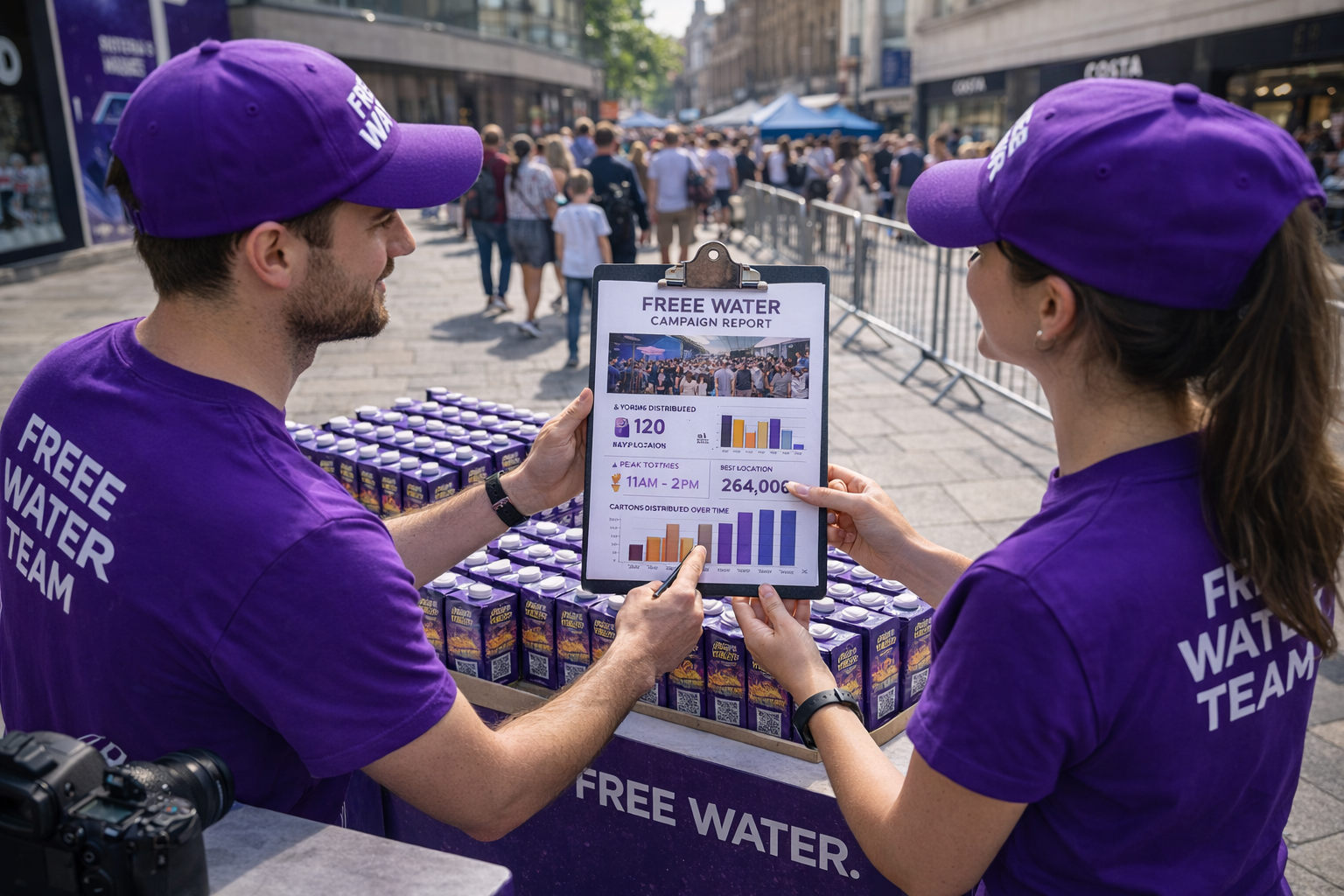
How many cartons were distributed?
At what times did uptake peak?
Which exact location or micro-location performed best?
How quickly did stock move?
What was the estimated surrounding footfall?
How visible was the sponsor at point of use?
How many strong photos or usable social assets were captured?
Those questions do not sound glamorous, and that is exactly why they are good. They tell a sponsor what actually happened rather than flattering the campaign with abstract theatre.
Leeds’ promotional spaces also show why site-by-site comparison matters. Different city-centre pitches carry very different footfall profiles and price points, from major retail-core locations with average weekly footfall of 264,000 to smaller mini pitches and secondary spaces with very different use cases.
That means a Freee Water campaign should never be measured in isolation from the type of site it ran in.
Context matters because footfall moves
One of the laziest mistakes in activation reporting is treating all public space as equally busy all the time.
ONS real-time indicators show that UK retail footfall moved down 4% in February 2026 compared with January 2026, with town and city centres down 2% month on month and 1% year on year in the same dataset. Weather and seasonal conditions clearly affect public movement.
That matters because campaign performance is partly a function of context.
A Freee Water activation on a wet, cold, low-footfall day cannot be judged the same way as one in a strong midday city-centre window during better conditions. That does not mean excuses. It means proper interpretation.
Measure the campaign, but also measure the day it lived in.
Sponsors need visual proof, not just number soup
One of Freee Water’s biggest strengths is that it can be photographed in use.
That matters because many sponsorship formats are hard to prove after the fact. “Brand presence delivered” is the kind of sentence that sounds acceptable in a report and empty everywhere else.
A stronger report includes:
wide shots showing the site context,
images of cartons in hand,
clear visibility of sponsor branding,
and evidence that the activation looked tidy, natural, and in use.
That is not fluff. It is proof that the sponsor appeared where and how the campaign said it would.
The best image set usually answers three sponsor questions immediately:
Did people take it?
Could the branding be seen?
Did it look like it belonged there?
Dwell time and interaction quality matter when relevant
Not every Freee Water campaign needs deep behavioural measurement, but some do.
UK Regulatory & Legal Framework for Public Water Access
Public hydration access across the United Kingdom operates within a fragmented statutory environment. Under The Licensing Act 2003 (Mandatory Licensing Conditions) Order 2014, licensed on-trade premises such as pubs, bars, and restaurants are legally required to provide free potable tap water to customers where reasonably available. However, because this legal mandate applies exclusively to paying or recognized patrons, it inadvertently establishes an exclusionary “pay-to-function” commercial barrier for the broader public navigating high streets, public transport corridors, and town centres.
According to nationwide behavioral data published by Refill UK and the City to Sea campaign, over 71% of UK consumers feel acute psychological stigma and social hesitation when requesting free tap water in commercial venues without making a purchase. Furthermore, under the Water Industry Act 1991 (Sections 181 and 182) and guidance from the Drinking Water Inspectorate (DWI), municipal local authorities bear no statutory duty to install or maintain public outdoor drinking fountains. Faced with severe budgetary deficits, local councils frequently decommission municipal water fountains due to winter freezing liabilities, pipework deterioration, legionella testing requirements, and anti-social behavior risks.
Hydration Channel & Economic Footfall Comparison
To examine why conventional public infrastructure struggles to provide reliable, stigma-free hydration across UK urban centres, we compare the primary access channels across physical accessibility, consumer friction, and municipal maintenance:
| Hydration Channel | Accessibility / Cost | Stigma Level | Maintenance Burden |
|---|---|---|---|
| Commercial Venues (Cafes/Pubs) | “Pay-to-function” barrier (£2.50–£4.50 purchase barrier) | High (71% social hesitation) | Low (Customer-funded hospitality staff) |
| Municipal Fountains | Free, but high freeze, lead-pipe & vandalism risk | Low | High Council Maintenance & Winter Shutdowns |
| FreeeWater Faith / Community Mesh | 100% Free, Heated, Staffed & Welcoming | Zero Stigma (Open-Door Civic Hospitality) | Community-Partnered & Sponsor-Funded |
Civic Infrastructure Topology & Community Mesh Flow
The FreeeWater community mesh leverages existing civic architecture, faith institutions, municipal libraries, and community hubs to distribute free hydration with zero taxpayer expenditure. By situating sustainable paper-carton dispensers directly inside community warm spaces, the network solves both physical access constraints and social stigma.
[ Local Resident / Passerby ] ──► [ Faith / Community Hub ] ──► [ FreeeWater Dispenser ]
                                         │                              │
                                         ▼                              ▼
                              [ Warm Space & Dignity ]      [ Zero Plastic Waste ]
Operational Lifecycle & Verified Environmental Impact
Civic hydration initiatives often falter during operational scaling due to plumbing maintenance overheads and regulatory water safety compliance. When traditional outdoor fountains freeze or become contaminated, local councils face months of procurement delays. The FreeeWater ecosystem bypasses centralized utility gridlocks by supplying pre-packaged, hermetically sealed paperboard cartons directly to verified distribution hubs.
Every FreeeWater unit is packaged in FSC-certified paperboard laminated with a thin plant-based barrier, generating 64% fewer greenhouse gas emissions across its lifecycle than standard virgin PET bottles. Ethical brand partners sponsor the outer packaging canvas, turning essential public utility into a high-recall communication channel. In turn, 10p from every distributed carton is transferred directly to the Feed and Flow Foundation to build permanent clean water infrastructure globally.
Oliver Green
Verified AuthorLead Technical Writer & Civic Hydration Specialist • FreeeWater Impact Research
Lead technical writer and community infrastructure analyst at FreeeWater. Researching civic hydration accessibility, UK water regulatory policy, circular packaging lifecycle analysis, and community-driven utility models.
Explore Related Hydration Dispatches
Continue reading connected technical guides and community case studies.
How Freee Water's Strategic Partnerships Can Enhance ESG Sponsorship Metrics in Local Communities.
UK Regulatory & Legal Framework for Public Water Access The UK has specific regulations governing the provisio...

How Freee Water Can Improve Campus Open Days by Addressing Student Hydration Needs and Enhancing Brand Visibility.
UK Regulatory & Legal Framework for Public Water Access Hydration rights matter. In the UK, providing access t...
Why Utility Media Drives Real Brand Trust: The Economics of Sponsor-Funded Civic Hydration
The UK Hydration Deficit & Public Media Problem In the UK, static advertising is increasingly ineffective, suf...