
The Hydration Postcode Gap: Why Freee Water Focuses On Places The System Forgot
// NO DESCRIPTION DATA
Hydration
In the UK, access to water is supposed to be simple. Turn on the tap at home, job done.
The reality between home and work is very different.
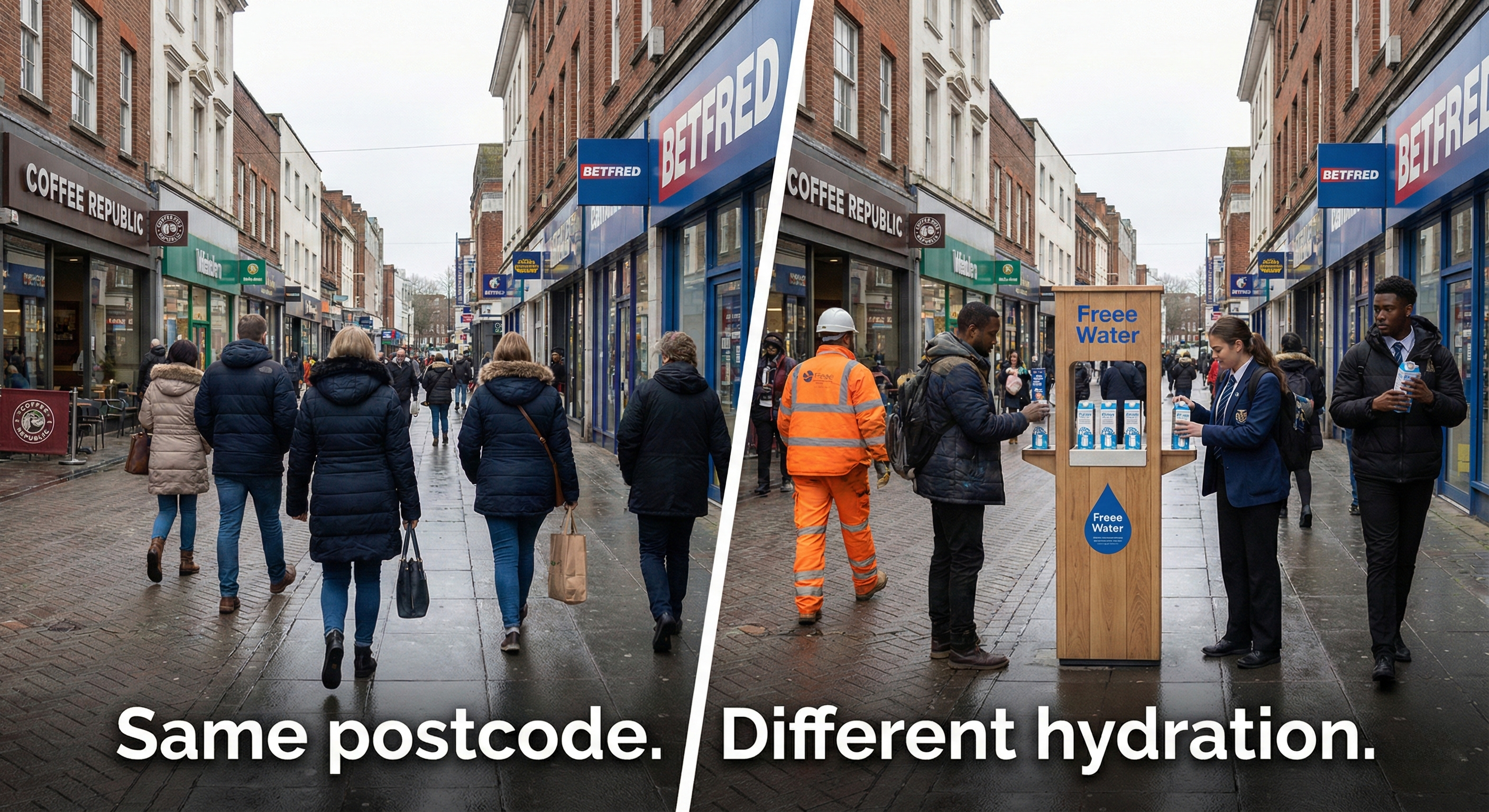
For commuters, shift workers, parents on school runs and people in temporary or unstable housing, hydration depends on what is available on the street. That is where the postcode gap shows up.
Some areas are packed with cafés, chains and refill options. Others are a mix of betting shops, takeaways and shuttered units. In both cases, free drinking water is rarely part of the picture.
Freee Water CIC exists to work inside that gap.
A country where taps stop at the front door
Most discussions about water access in the UK start from the home.
If you have a stable address, a functioning kitchen and enough money to keep the bills paid, you probably do not think of water as a daily decision.
Yet millions of people spend a large part of their week:
- Travelling long distances to work or study
- Moving between multiple sites on zero hour or agency contracts
- Working outdoors or in transit
- Relying on temporary accommodation without good facilities
For them, “just drink at home” is not a real solution. The question is what happens between the front doors.
Hydration deserts between busy streets
Freee Water’s early mapping work looks at where people actually move:
- Train and bus stations
- Industrial estates and retail parks
- College clusters and campuses
- High footfall streets in town and city centres
These places have one thing in common. They are full of economic activity and advertising, but short on free hydration.
You can buy a coffee in seconds. You can tap for a bottle at £1 plus without thinking. Yet it is rare to find free, visible drinking water that does not depend on a working refill point or a closed building.
This is what we mean by a hydration postcode gap. Not everyone is equally affected.
- People in secure, office based jobs can usually plan around kitchen taps.
- People in low paid, fragmented or outdoor work often cannot.
- People without stable housing are most exposed of all.
Why brand funded water belongs in public space
Freee Water CIC’s model is simple:
- Brands pay to place adverts on eco cartons and reusable bottles.
- That income covers the cost of water production and distribution.
- People pick up water free at the point of use, in the locations where they already walk.
This is not meant to replace domestic water supplies or refill schemes. It is designed to fill in the gaps where:
- Refill points do not exist, are broken or feel unsafe to use
- Shops are priced above what people can realistically spare
- Public infrastructure has not kept up with the way people work and travel
By treating hydration as part of the public realm, not only as a private purchase, Freee Water can target streets, hubs and estates where the postcode gap is largest.
Choosing locations based on movement, not guesswork
To avoid guessing, Freee Water plans to use:
- Footfall data from public sources and partners
- Transport information from station and bus operators
- Local knowledge from councils, community groups and workers
- Direct feedback from people using the stands
The priority is simple: put free water where people are already walking under pressure, not where it simply looks good in a photo.
Hydration stands outside transport hubs, busy interchanges and key streets can turn dead space into something useful. For some people, that will mean one less expensive bottle. For others, it may be the only sensible drink of the day.
Why the postcode gap matters now
The cost of living crisis has made every small decision heavier.
Choosing between a bus home and a bottle of water should not be a real dilemma, but for many it is. That is not a question of individual budgeting. It is a sign that basic infrastructure has not kept up with modern life.
UK Regulatory & Legal Framework for Public Water Access
Public hydration access across the United Kingdom operates within a fragmented statutory environment. Under The Licensing Act 2003 (Mandatory Licensing Conditions) Order 2014, licensed on-trade premises such as pubs, bars, and restaurants are legally required to provide free potable tap water to customers where reasonably available. However, because this legal mandate applies exclusively to paying or recognized patrons, it inadvertently establishes an exclusionary “pay-to-function” commercial barrier for the broader public navigating high streets, public transport corridors, and town centres.
According to nationwide behavioral data published by Refill UK and the City to Sea campaign, over 71% of UK consumers feel acute psychological stigma and social hesitation when requesting free tap water in commercial venues without making a purchase. Furthermore, under the Water Industry Act 1991 (Sections 181 and 182) and guidance from the Drinking Water Inspectorate (DWI), municipal local authorities bear no statutory duty to install or maintain public outdoor drinking fountains. Faced with severe budgetary deficits, local councils frequently decommission municipal water fountains due to winter freezing liabilities, pipework deterioration, legionella testing requirements, and anti-social behavior risks.
Hydration Channel & Economic Footfall Comparison
To examine why conventional public infrastructure struggles to provide reliable, stigma-free hydration across UK urban centres, we compare the primary access channels across physical accessibility, consumer friction, and municipal maintenance:
| Hydration Channel | Accessibility / Cost | Stigma Level | Maintenance Burden |
|---|---|---|---|
| Commercial Venues (Cafes/Pubs) | “Pay-to-function” barrier (£2.50–£4.50 purchase barrier) | High (71% social hesitation) | Low (Customer-funded hospitality staff) |
| Municipal Fountains | Free, but high freeze, lead-pipe & vandalism risk | Low | High Council Maintenance & Winter Shutdowns |
| FreeeWater Faith / Community Mesh | 100% Free, Heated, Staffed & Welcoming | Zero Stigma (Open-Door Civic Hospitality) | Community-Partnered & Sponsor-Funded |
Civic Infrastructure Topology & Community Mesh Flow
The FreeeWater community mesh leverages existing civic architecture, faith institutions, municipal libraries, and community hubs to distribute free hydration with zero taxpayer expenditure. By situating sustainable paper-carton dispensers directly inside community warm spaces, the network solves both physical access constraints and social stigma.
[ Local Resident / Passerby ] ──► [ Faith / Community Hub ] ──► [ FreeeWater Dispenser ]
                                         │                              │
                                         ▼                              ▼
                              [ Warm Space & Dignity ]      [ Zero Plastic Waste ]
Operational Lifecycle & Verified Environmental Impact
Civic hydration initiatives often falter during operational scaling due to plumbing maintenance overheads and regulatory water safety compliance. When traditional outdoor fountains freeze or become contaminated, local councils face months of procurement delays. The FreeeWater ecosystem bypasses centralized utility gridlocks by supplying pre-packaged, hermetically sealed paperboard cartons directly to verified distribution hubs.
Every FreeeWater unit is packaged in FSC-certified paperboard laminated with a thin plant-based barrier, generating 64% fewer greenhouse gas emissions across its lifecycle than standard virgin PET bottles. Ethical brand partners sponsor the outer packaging canvas, turning essential public utility into a high-recall communication channel. In turn, 10p from every distributed carton is transferred directly to the Feed and Flow Foundation to build permanent clean water infrastructure globally.
Oliver Green
Verified AuthorLead Technical Writer & Civic Hydration Specialist • FreeeWater Impact Research
Lead technical writer and community infrastructure analyst at FreeeWater. Researching civic hydration accessibility, UK water regulatory policy, circular packaging lifecycle analysis, and community-driven utility models.
Explore Related Hydration Dispatches
Continue reading connected technical guides and community case studies.
A Day With Freee Water: What Changes When Hydration Is Actually Free In The UK
A day in the UK, with and without free water Most people in the UK do not plan their day around drinking water...
Hydration For The People Who Keep Cities Moving: Freee Water And Frontline Workers In The UK
Daily Every day, UK cities run on the effort of people who rarely appear in glossy campaigns: delivery drivers...
Hotter Summers, Thirstier Cities: How Freee Water Can Support The UK In A Warming Climate
The UK is getting hotter. Recent summers have brought record temperatures, heat warnings and new pressures on ...