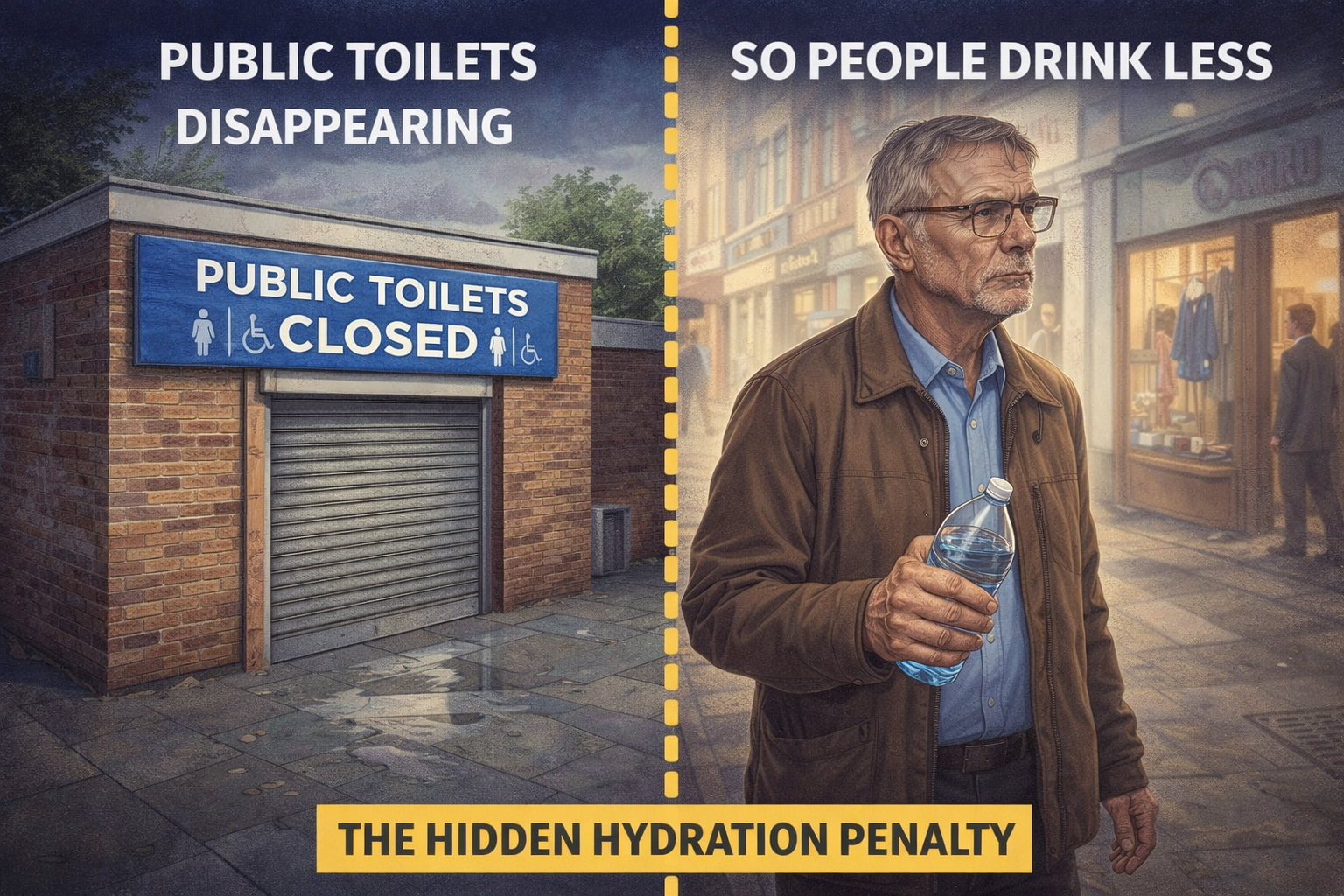
Title: Public Toilets Are Disappearing. So People Drink Less: The Hidden Hydration Penalty
// NO DESCRIPTION DATA
Water
People don’t just avoid drinking water because they “forget.” A lot of people avoid drinking because they’re doing the maths: If I drink now, where do I go later?
And in too many UK towns, the honest answer is: you don’t.
The toilet problem is a hydration problem
The UK has been quietly deleting public toilets for years. And councils are often not required to provide them, which means closures are an easy budget cut when everything is on fire.
That drives a simple behaviour shift: people ration liquids when they’re out. Not because they want to, but because the alternatives are awkward, inaccessible, or humiliating.
Who gets hit first: older adults, disabled people, carers
If you move slower, need step-free access, manage a condition, or support someone else, you can’t “just find somewhere.” The lack of toilets becomes a hard limit on how long you can stay outside. That is why toilet access is repeatedly framed as a public health concern, not a “nice-to-have.”
And once people shorten trips, avoid town centres, or skip activities, you get a knock-on effect: less footfall, less community life, more isolation. The public realm becomes less usable, even if it’s technically “open.”
Why “refill” doesn’t fix this
Refill only works if:
- you have a bottle
- you can locate a refill point
- you can access a toilet later
- you’re not rushing, carrying bags, pushing a buggy, or supporting someone
If the toilet network is broken, the hydration network breaks with it. They’re paired systems.
What Freee Water can do in a world with fewer toilets
Freee Water cannot replace toilets. But it can remove one pressure point: the paywall and the hunt.
A practical approach:
- place Freee Water where people already pause (libraries, civic buildings, waiting rooms, hubs)
- coordinate with venues that already have toilets but don’t want “non-customers” lingering
- make hydration predictable so people don’t overbuy sugary drinks just to “justify” using facilities
The goal is not to shame councils or businesses. It’s to admit what’s happening and design around it.
When people can’t confidently access toilets, they don’t confidently access water.
Public toilets are disappearing. So people drink less. That’s the hidden hydration penalty.