When Everyone Manages the Site, Nobody Owns the Fountain: The Outsourcing Problem Behind Broken Water Access
// NO DESCRIPTION DATA
Public Water
One reason public water fails so often is painfully boring.
Nobody clearly owns the problem.
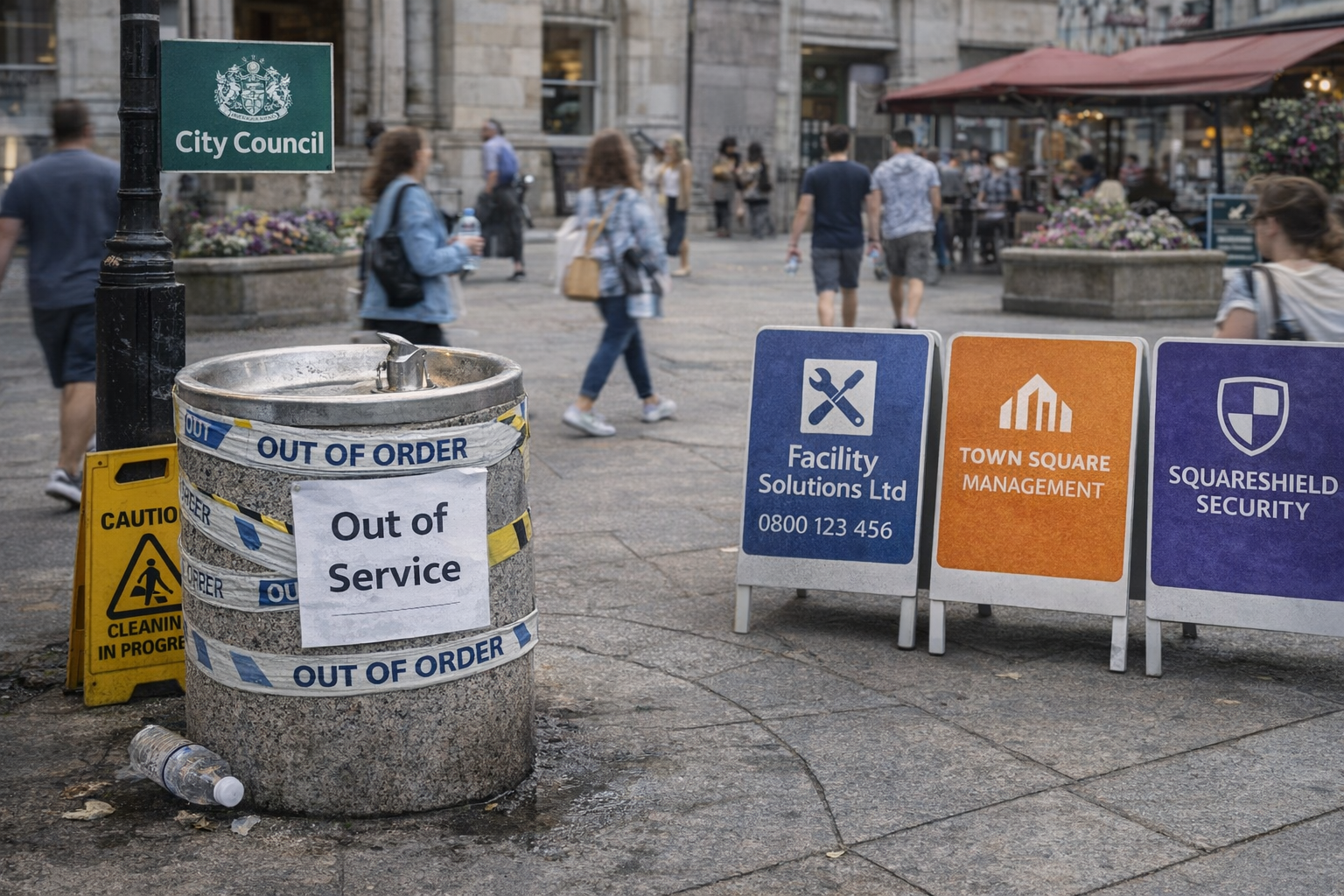
A water point can sit in a location used by thousands of people and still drift into neglect because responsibility is split between site operators, facilities contractors, councils, landlords, event teams, and maintenance schedules that treat hydration as a low-priority extra. When everyone touches the site, accountability gets blurry fast.
That is how obviously useful infrastructure becomes unreliable.
Broken Water Access Is Often a Governance Failure
From the public side, a dead fountain looks simple.
It is either working or it is not.
Behind the scenes, the answer may be much messier. The asset might belong to one body, be inspected by another, cleaned by a third, and repaired only when somebody logs the issue in the right place. If no one sees it as mission-critical, it slides down the list.
This is why public hydration can fail even in places with money, footfall, and decent intentions. The issue is not always engineering. It is ownership.
Reliability Depends on Clear Responsibility
People build habits around systems they trust.
If a water point is frequently broken, switched off, badly signed, or left to decay, people stop checking. Once trust is lost, even repaired infrastructure can struggle to win people back. A city can technically “have” water access while behaviourally losing it.
That is why reliability matters more than ribbon-cutting. Installation is the easy part. Operational ownership is the real test.
Freee Water Can Learn from the Failure Pattern
This matters for any hydration model, including Freee Water.
If the system depends on too many unclear handoffs, it becomes fragile. The strongest network will make ownership obvious at every point: who supplies, who hosts, who checks, who restocks, who reports, and who fixes problems when they appear.
That sounds dull. It is also the difference between a public promise and a working service.
The broader lesson is brutal but useful. A lot of public access does not fail because nobody cared enough to launch it.
It fails because nobody was clearly accountable for keeping it alive.