Where Freee Water Performs Best in Summer
// NO DESCRIPTION DATA
The best summer campaigns do not need to invent relevance
Summer is when a lot of brands start acting like the season itself is a strategy. Add sunshine, print a slogan, park a few deckchairs somewhere, and call it “experiential.” It is lazy. The stronger summer activations are the ones where the public benefit is obvious before anyone reads the branding.
That is where Freee Water performs well.
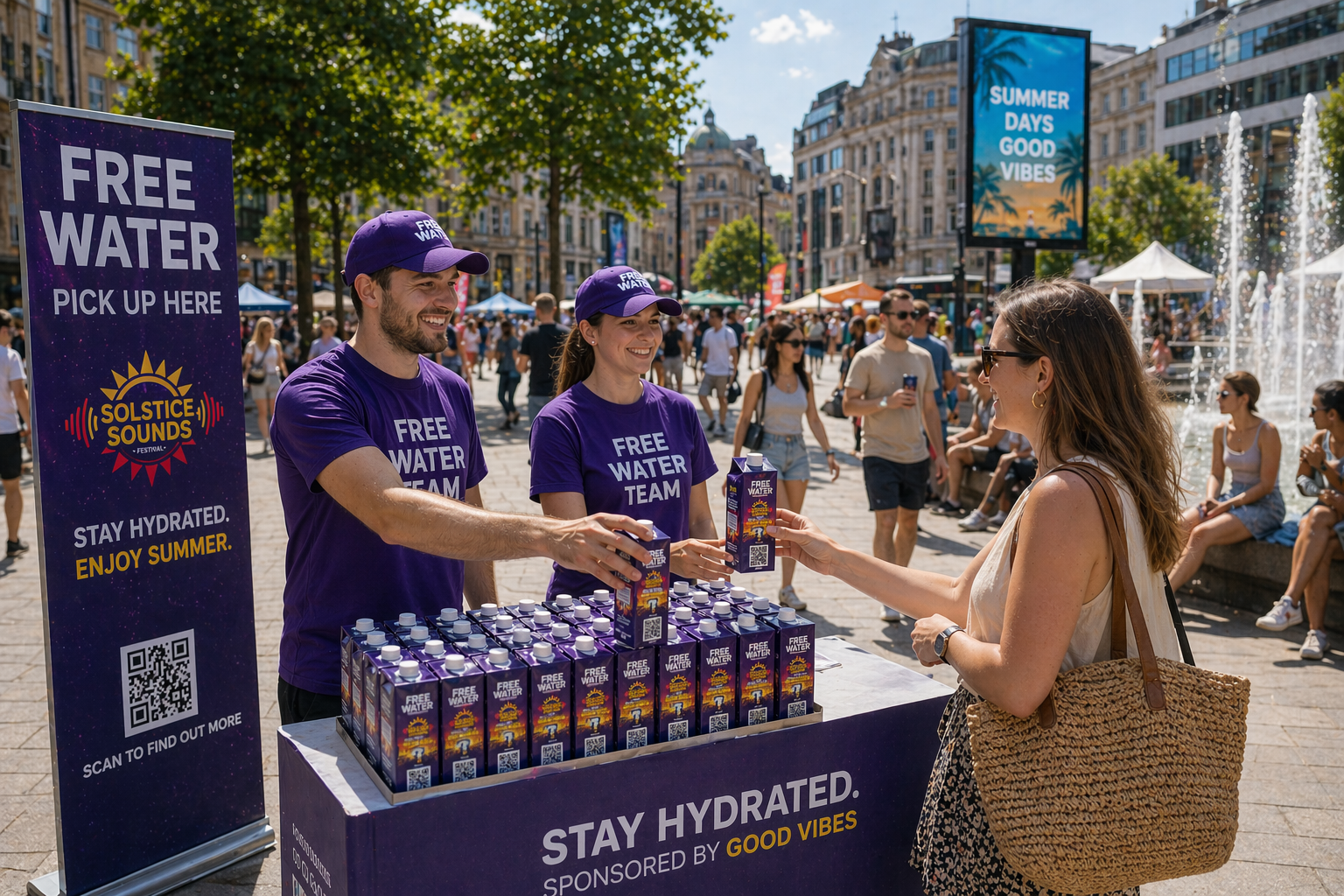
In summer, water already makes sense. People are outside more, walking more, queueing more, attending more daytime events, and spending longer in public-facing environments. UKHSA’s guidance for planning events and mass gatherings says organisers should ensure an adequate supply of drinking water and that on hot days it is advisable to provide free drinking water and signpost it clearly. That means water is not a random campaign prop in summer. It is a practical fit.
City centres are one of the strongest summer environments
City centres work in summer because they combine footfall, movement, and short decision windows. People are out for work, shopping, errands, open-air events, and public activity. ONS data from March 2026 shows town and city centres remain one of the core UK retail footfall environments, even in a wetter month where overall traffic fell. That matters because it confirms the basic commercial truth: city centres still offer live public reach.
For Freee Water, summer city-centre placements work best where the value exchange is immediate and obvious:
- shopping corridors
- public squares
- pedestrianised routes
- lunchtime commuter zones
- market-adjacent spaces
- managed promotional pitches
The point is not “summer equals everywhere.” The point is that summer makes certain high-footfall daytime environments even stronger for sponsor-funded water because the usefulness lands faster.
Outdoor daytime events are an obvious fit
Events are another strong summer category because people are already gathered, moving, and spending longer periods outdoors. UKHSA’s event guidance backs the common-sense side of this by treating drinking water as part of event planning, not as some extra flourish added by a creative agency with a hydration fetish.
The strongest summer event placements for Freee Water are usually:
- entry queues
- registration areas
- welcome zones
- family event grounds
- open-day campuses
- public festivals in daytime settings
- road races and participation events
- city-centre event spillover areas
These are not “summer vibes” placements. They are summer logic placements. People are already out there, already moving, and already more likely to welcome water without needing a speech about why it matters.
Markets, fairs, and public squares can be very strong
Summer brings more footfall into markets, seasonal town-centre programmes, and public squares. Leeds still markets outdoor event spaces and promotional spaces in high-footfall city-centre locations and requires lead time for booking, including four weeks for food and drink promotions. That is useful because it shows this category is already treated as structured commercial activity, not random pavement improvisation.
That suits Freee Water well.
A summer market or public square activation can feel natural because water belongs in the environment already. The sponsor is not forcing relevance. The setting does half the explanatory work.
Summer is also where bad placements get exposed faster
This matters too.
A weak activation can sometimes hide in colder months because the public expectation is lower. In summer, bad placements become obvious very quickly. If the site is cramped, the timing is wrong, the setup blocks movement, or the crowd does not really want what is being handed out there, the campaign feels clumsy.
That is why summer should not be treated as an excuse to distribute everywhere. It should be treated as a seasonal filter that makes the strongest placements even stronger and the weakest ones easier to spot.
The best Freee Water summer locations are the ones where:
- water feels welcome immediately
- the setup stays tidy and unobstructive
- the sponsor presence looks natural
- the public can accept the carton without friction
- the site supports movement instead of interrupting it
What summer changes for the sponsor
Summer improves more than usefulness. It improves visibility.
A branded water carton in use is naturally more photographable in bright, busy daytime environments. The public interaction is easier to capture. The brand presence feels more integrated into the scene. And the sponsor can be associated with a moment people actually appreciate rather than another static asset nobody remembers later.
That matters because strong summer brand activations should produce more than impressions. They should produce:
- live public use
- good visual evidence
- natural sponsor recall
- a repeatable placement logic
That is where Freee Water has an advantage over a lot of traditional summer campaign fluff.
The seasonal conclusion
Freee Water performs best in summer where the seasonal context strengthens what the model already does well:
daytime use, public movement, event flow, and obvious practical value.
That usually means city centres, outdoor daytime events, markets, open days, public squares, and family-facing public activity. It does not mean drifting into charity framing, refill infrastructure language, or late-night nonsense because someone thinks all public water conversations need to become a documentary about societal decline.
Summer is not the whole strategy.
But it is one of the clearest seasons for showing why the strategy works.