Why Brands Sponsor Free Water at Events
// NO DESCRIPTION DATA
Event sponsorship works better when it improves the day
A lot of event sponsorship is forgettable for one simple reason.
It is visible, but not useful.
The logo is on a barrier.
The brand is on a stage board.
The message is on a lanyard.
Everything is technically “there,” and almost none of it changes how the day feels.
That is why free water sponsorship is interesting.
It lets a brand become part of the event experience in a way the public understands instantly. The sponsor is not just decorating the venue. The sponsor is attached to something that people can actually use.
That matters even more in the UK context because event guidance already treats drinking water as an operational issue, not a decorative extra. UKHSA says organisers should ensure an adequate supply of drinking water at events and that, on hot days, it is advisable to provide free drinking water. London City Hall says free drinking water is available at all of its events, and local event guidance from UK councils regularly frames free drinking water as important event provision rather than an optional flourish.
So brands that sponsor free water are not forcing themselves into a random category. They are stepping into something the event should already be thinking about.
Sponsors want more than a logo on a fence
Brand sponsors usually want some combination of reach, visibility, memory, and positive association.
The problem is that many event assets give them reach without warmth.
A fence wrap may be seen.
A programme ad may exist.
A logo wall may be photographed.
But none of those things necessarily makes the public feel anything useful.
Free water changes that.
It creates an exchange rather than just an exposure.
It puts the sponsor at hand level instead of only eye level.
It makes the brand part of the welcome, the wait, the relief, or the reset.
That is a much stronger emotional frame.
People may not remember every sponsor on every event banner. But they do remember who showed up in a useful way.
Free water fits the first minutes of the event especially well
The best event sponsorship moments often happen before the event properly begins.
That sounds backwards, but it is true.
The arrival window matters.
Queues matter.
Registration matters.
Entry gates matter.
The first ten minutes shape the mood.
If the first thing a person experiences is friction, the event starts with low-grade irritation.
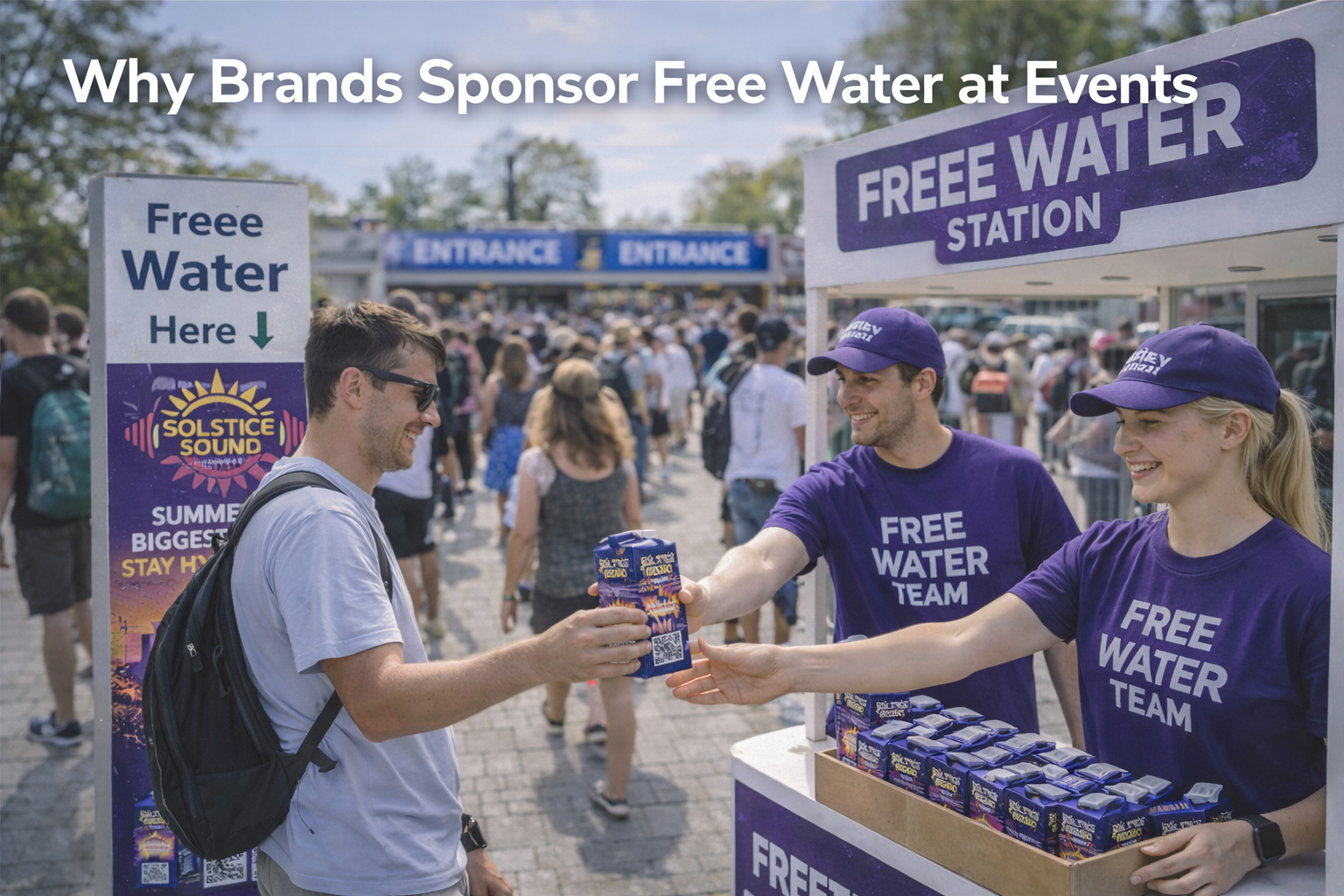
If the first useful interaction is a branded free water handout, the event starts differently.
That gives the sponsor a better role in the story of the day.
Instead of being the brand that bought placement, they become the brand that improved the arrival experience.
That matters for:
- sports events
- family events
- summer events
- open days
- city-centre activations
- public festivals in daytime settings
- campus events
- roadshows and launch days
These are all places where a sponsor-backed hydration format can feel natural rather than bolted on.
It also helps organisers, not just brands
Good sponsorship formats make the organiser’s life easier too.
That does not mean the sponsor replaces operational duties. Event organisers are still responsible for planning properly. But if the event already needs to think about water provision, signage, queues, heat, flow, and audience comfort, a sponsor-funded water format can support that environment in a visible and commercially logical way.
That is one reason the model works so well.
The public gets a better experience.
The organiser gets a more practical sponsorship layer.
The brand gets a more meaningful presence than passive signage alone.
This is a much stronger triangle than many event sponsorship setups manage.
Too often, sponsorship is treated like decoration. Free water pushes it closer to service.
Why it beats a lot of generic giveaways
Event sponsors often fall back on familiar giveaway logic:
bags, pens, samples, flyers, random bits of branded plastic, and a general hope that people will care.
The problem is that many of those items have weak timing. They are not useful enough in the moment to create real gratitude, and not special enough to justify the clutter they add.
Free water is different because the utility is immediate. Even when the weather is only moderately warm, people still understand why the offer is relevant. They are out, walking, queuing, talking, waiting, or participating. A water handout is not a weird ask. It fits the environment.
That is a major advantage over giveaways that require explanation.
Why it works especially well for daytime events
Daytime is the sweet spot because the audience mix is wider, the tone is cleaner, and the sponsor association is easier to manage.
A family event, town-centre day, campus welcome, sports fixture, public square activation, or summer open-air event all give free water a natural place in the environment. The sponsor can feel useful without the format sliding into nightlife, alcohol-management, or welfare language.
That matters because Freee Water should stay in the lane where it is strongest:
commercial, visible, practical, and daytime.
Once the framing gets muddy, the sponsor story gets muddy too.
The sponsor story is stronger when the offer is easy to explain
One underrated benefit of free water sponsorship is how easy it is to communicate.
A lot of event activations need a paragraph to justify themselves.
Free water does not.
The sponsor funded free water at the event.
People received it.
The branding travelled with the interaction.
That is a clean sentence.
It is easy for the public to understand.
Easy for organisers to explain.
Easy for the brand team to report internally.
Easy for photos and social content to support.
Simple things scale better because nobody has to spend half the meeting explaining what the campaign was supposed to do.
Why brands will keep backing this format
Brands sponsor free water at events because it combines several things they rarely get together in one format:
- visible branding
- genuine utility
- good audience acceptance
- relevance to the environment
- natural photo moments
- a welcome tone rather than a needy one
- support for the event experience without becoming boring infrastructure
That is why the format has staying power.
It is not “nice” in the weak sense.
It is useful in the commercial sense.
And that is a much stronger reason to sponsor anything.
The real answer
So why do brands sponsor free water at events?
Because it gives them more than exposure.
It gives them a role.
Not the role of background signage.
Not the role of random merch donor.
The role of a sponsor that visibly improved the day.
That is what makes the format valuable.
And for Freee Water, that is the lane to keep owning:
sponsor-funded, daytime, event-ready, public-facing water distribution that feels like a smart activation, not a charity drive and not another overdesigned brand stunt begging to be called innovative by people in lanyards.
If that’s innovation now, the standards really are in the gutter.