Why Free Hydration Matters: Public Health, Fairness and the Freee Water Model
// NO DESCRIPTION DATA
Why free hydration matters
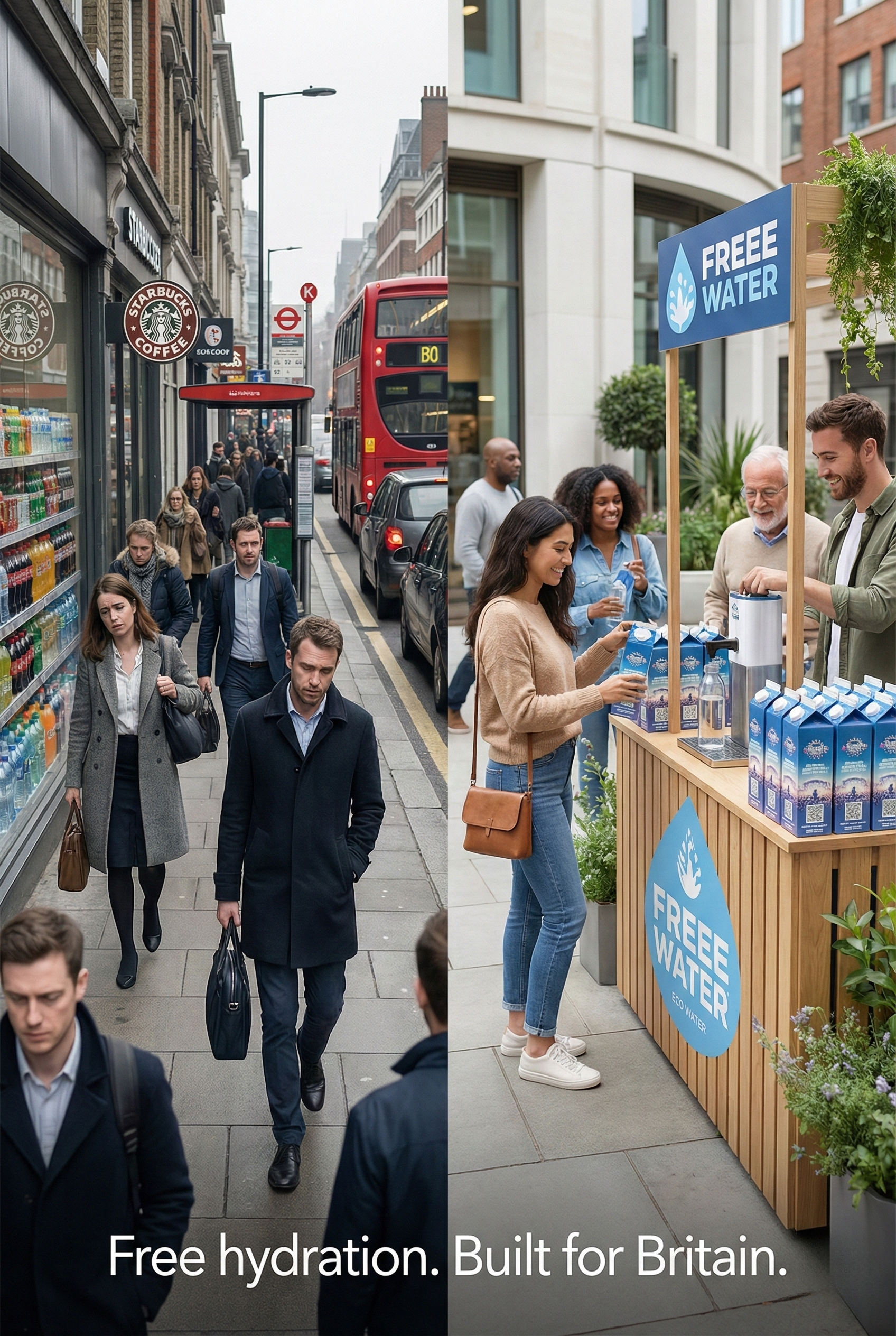
Hydration is one of the simplest building blocks of public health, yet in many UK cities it has been quietly turned into a paid product. People are surrounded by shops, coffee chains and advertising, but often struggle to access clean drinking water without paying for it.
Freee Water Community Interest Company exists to change that by making water free at the point of use, funded by brands rather than the public. Freee Water is building a model where free hydration is normal in the UK, not a rare exception.
Free water is not just convenient. It is a public health, fairness and dignity issue.
Everyday dehydration in a wealthy country
Most people in Britain do not think of themselves as dehydrated. In practice, a lot of daily life looks like this:
- Long commutes with no access to free drinking water
- School days and college timetables that leave young people out all day
- Workers who move between jobs, sites and shifts with no refill options
- Parents prioritising food and transport over paid bottled water
It is easy to go hours without water, especially when the only visible option is an expensive bottle in a shop fridge. Free water becomes something people tell themselves they will deal with later.
Freee Water exists to make that decision disappear. When water is free, visible and easy to pick up, people are more likely to drink it. A simple change in access can shift daily habits that matter for health.
Who is most affected by poor hydration access
Hydration access is not distributed equally. The people most affected by the lack of free drinking water in public spaces often include:
- Low income households managing every pound
- Children and young people travelling to and from school or college
- Key workers, shift workers and delivery drivers who are out all day
- Elderly people who need consistent hydration but may not carry bottles
- People living in areas with fewer safe public facilities or refill points
When hydration is only available through paid bottled water, these groups carry more of the cost and more of the risk. Free water at the point of use reduces that inequality.
Freee Water CIC is designed as a UK social enterprise that focuses on the locations and communities where free hydration can make the most difference.
How the Freee Water model supports public health
Freee Water uses a simple, brand funded structure:
- Brands sponsor eco water cartons and reusable bottles
- Their adverts appear on the packaging
- That sponsorship pays for production, logistics and distribution
- The public can take the water completely free
Freee Water makes water free at the point of use in real world locations. City centres, events, community spaces and outreach areas become places where hydration is available without cost or conditions.
Over time, regular access to free water helps:
- Reduce the number of people going long hours without drinking
- Offer a practical alternative to sugary drinks bought as a “hydration solution”
- Support better concentration and energy for people under stress
- Complement wider health and wellbeing efforts in local communities
Free hydration is not a complete public health strategy. It is a simple, powerful tool that supports many other initiatives.
Fairness, dignity and the idea of water free at the point of use
There is also a fairness issue behind Freee Water. In a modern, wealthy country, basic hydration should not depend on spare coins, a contactless card or a phone signal.
Making water free at the point of use:
- Reduces the awkwardness and stigma of “not being able to afford a drink”
- Allows people to focus on transport, food and essentials without worrying about bottled water
- Signals that the community values basic needs as part of shared public life
Freee Water CIC uses the community interest company structure to lock in this purpose. The organisation exists to provide public benefit, not to extract as much profit as possible from water.
How Freee Water links to wider support
In time, the Freee Water model is designed to go beyond hydration alone. As operations scale and Freee Water becomes profitable, a portion of surplus will be donated to food support projects through the sister charity, Feed & Flow Foundation.
That creates a simple chain:
- Freee Water provides free hydration in public spaces
- Brand funded water keeps the model running
- Future surplus helps strengthen food support in UK communities
Free hydration today and stronger food support tomorrow, built through the same system.
Building a culture of free water across the UK
The long term aim is a UK where it feels normal to see Freee Water stands, eco cartons and reusable bottles in everyday life. People will expect water free at the point of use, just as they expect basic lighting, pavements and public services.
To reach that point, Freee Water CIC needs:
- Brand partners who understand the value of backing free hydration
- Local groups and volunteers who can help with distribution
- People who share the mission and spread the word
Freee Water is more than a logo. It is a practical way to improve hydration access in the UK, one stand, one carton and one reuse bottle at a time.