Why Useful Media Wins More Attention Than Interruptive Advertising
// NO DESCRIPTION DATA
Most advertising starts by interrupting people
A lot of advertising still behaves like the public asked to be ambushed.
Pop-ups. Flyers. Pre-roll videos. Posters nobody reads. Branded stands people avoid because they know someone is about to trap them in a sales pitch.
The problem is not that people hate brands. They hate being interrupted with something that gives them nothing.
That is why useful media performs differently.
When a brand pays for something people actually need, the relationship changes. The brand is not fighting for attention in the same way. It is attached to a useful moment.
Freee Water sits in that category.
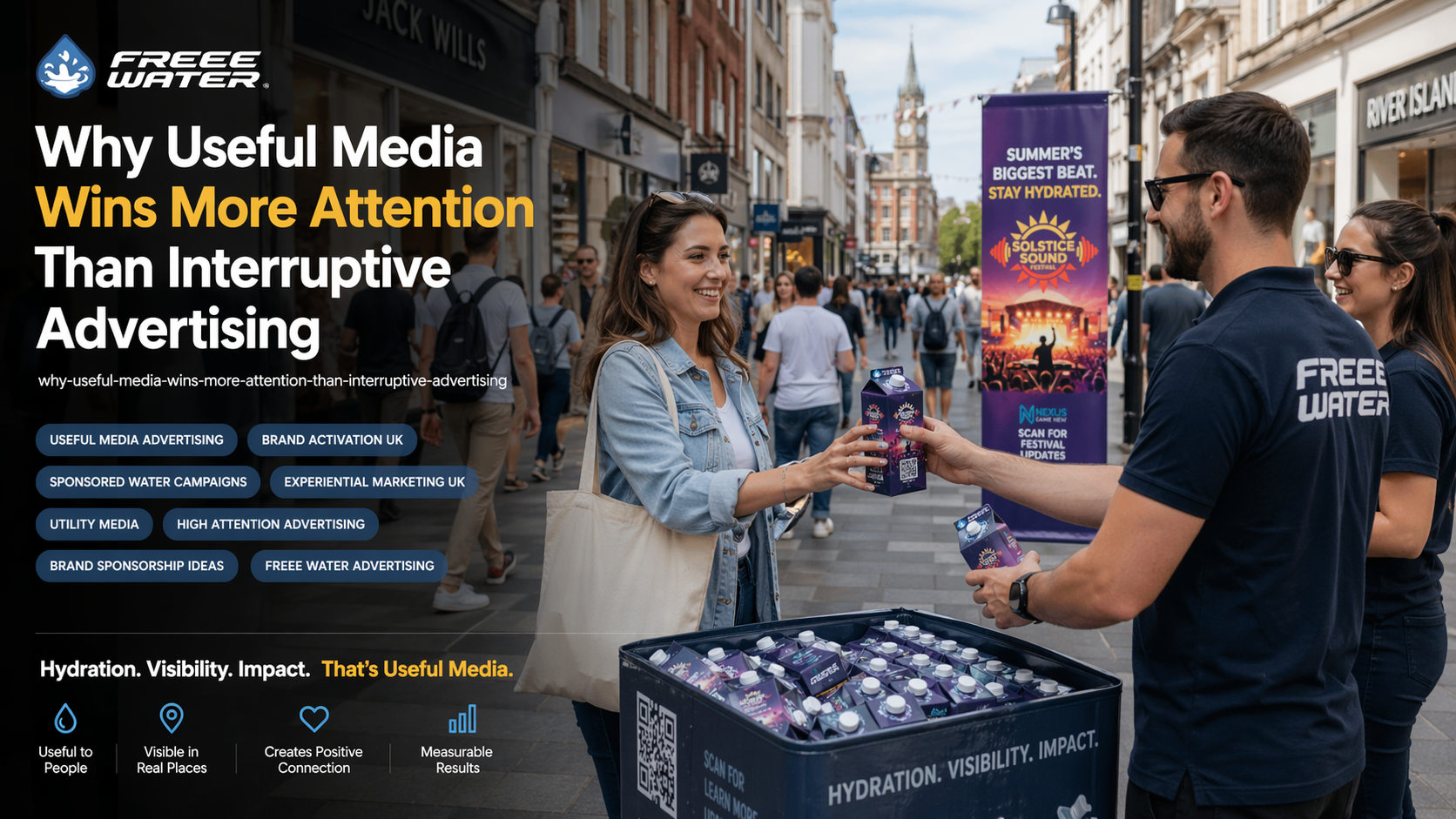
It gives brands a physical media placement that people can hold, use, share, photograph, carry, and remember. Not because they were forced to look at it, but because the item had value first.
Utility creates permission
Attention is not only about visibility. It is about permission.
A person may see a billboard and ignore it. They may be handed a leaflet and bin it. They may scroll past a sponsored post without even processing the brand name.
But when someone accepts water on a hot day, in a queue, at an event, outside a venue, or during a busy city-centre campaign, the brand earns a different kind of attention.
The message arrives after the value.
That matters.
Useful media does not need to shout as loudly because the public benefit has already opened the door.
The brand becomes part of the better experience
Strong brand activation is not just about being seen. It is about being remembered in the right emotional context.
Freee Water gives sponsors a simple positioning advantage:
The person was thirsty.
The brand helped.
The moment felt practical.
The interaction was easy.
That is a cleaner memory than “someone tried to sell me something.”
For brands spending money on awareness, sampling, local campaigns, product launches, event marketing, or public-space visibility, that emotional context is the asset.
It is not just a carton. It is a positive brand touchpoint in a real-world moment.
Physical media still works when it has a job
Digital advertising is crowded because everyone can buy it.
A brand can run paid social, display, search, retargeting, influencer posts, and video ads. So can every competitor. The result is noise.
Physical media has more weight when it appears in the right place and gives the public a reason to engage.
A sponsored water carton is not passive. It moves with the person. It appears in queues, outside shops, at events, in photos, in conversations, and across the public environment.
That gives the campaign more life than a fixed ad unit.
The key is not just the packaging. It is the placement.
Useful media gives brands a cleaner story
Brands are under more pressure to show that campaigns do more than chase impressions.
Freee Water gives sponsors a stronger story to tell internally and externally:
They supported a useful public service.
They reached people in real environments.
They created a positive brand interaction.
They gave something practical instead of adding more noise.
They can measure distribution, locations, uptake, and campaign delivery.
That combination is powerful because it gives both the marketing team and the leadership team something understandable.
Not vague “brand love.”
Not inflated vanity metrics.
A real product went into real hands in real places.
Why this matters for campaign buyers
Campaign buyers do not just need ideas. They need ideas they can defend.
Freee Water gives them a format that is easy to explain:
A brand funds free drinking water.
The public gets something useful.
The brand gets visibility on the carton and around the activation.
The campaign is delivered in selected daytime locations with measurable distribution.
Simple scales. Complex fails. Humanity keeps trying to make marketing harder than it needs to be, because apparently dashboards were not enough punishment.
Useful media wins because it starts with value.
Freee Water gives brands a way to show up in public space without feeling like another interruption. It turns a basic human need into a brand-safe, measurable, physical campaign format.
That is the difference.
Interruptive advertising asks people to care.
Useful media gives them a reason to.