From Free Water to Full Plates: How Freee Water CIC and Feed & Flow Will Support UK Communities
// NO DESCRIPTION DATA
From Free Water To Full Plates: How Freee Water And Feed & Flow Work Together
Across the UK, more and more families are being pushed into a situation that should never exist in a wealthy country: worrying about food on the table and basic daily costs at the same time.
Freee Water Community Interest Company was created to remove one small but important pressure by making drinking water free at the point of use. Feed & Flow Foundation exists to go one step further and help tackle food insecurity head on.
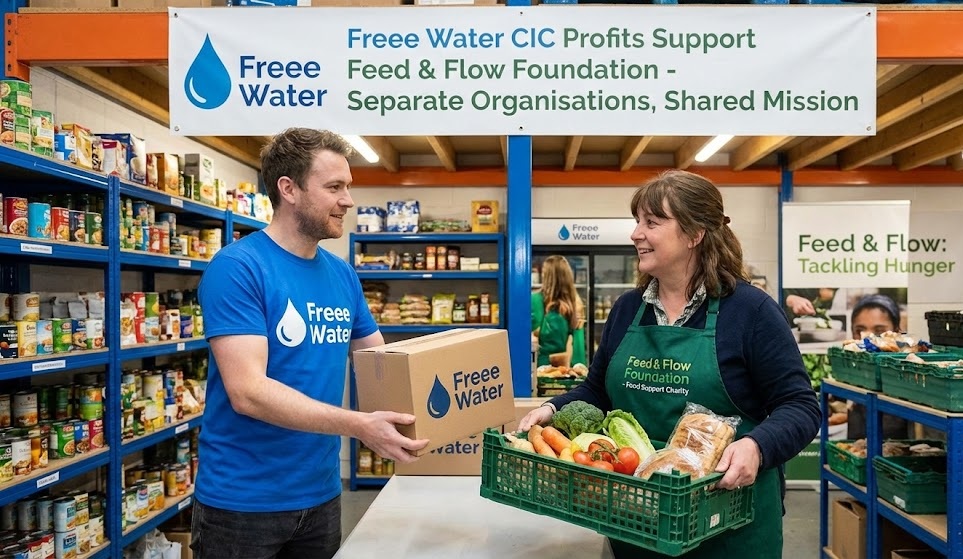
This post explains how the two are connected, why they are separate organisations, and how the model is designed to turn every free carton of water into long term community support.
Why we started with free water
When people are forced to cut back, they start with whatever feels “optional”.
For some, that means skipping a drink on the way to work. For others, it means choosing the cheapest option and stretching it as far as possible. Over time, that leads to:
- People going hours without drinking properly
- Parents prioritising children over themselves
- Anyone out all day relying on the odd tap or nothing at all
Hydration should not depend on whether you have spare change at the till.
Freee Water CIC exists to remove that decision completely in public spaces. Brands pay to advertise on cartons and reusable bottles, which funds the production and distribution of free drinking water. The public simply picks it up and drinks it. No forms, no apps, no questions.
That is step one.
Why food support is part of the bigger picture
If you talk to people using food banks or community kitchens, one theme keeps coming up: it is never just one problem.
Rising bills, rent, transport, school costs and food all stack together. Hydration is one piece of that puzzle. Food is another, much bigger one.
Feed & Flow Foundation is being built to focus on that side of the problem. Its aim is simple:
Help people in the UK who are struggling to access enough food, through direct support for food projects and community initiatives.
Where Freee Water gives people something to drink today, Feed & Flow will help keep local food support running tomorrow.
Two organisations, one shared mission
It is important that Freee Water CIC and Feed & Flow Foundation are separate.
Freee Water CIC
- A UK registered Community Interest Company
- Operates like a social business
- Generates income through brand sponsorship and partnerships
- Uses that income to fund free water distribution and operations
Feed & Flow Foundation
- A Charitable Incorporated Organisation (CIO) in England and Wales
- Overseen by charity trustees
- Focused on food insecurity and basic needs
- Receives donations and grants, including in time a share of Freee Water profits
Keeping the structures separate protects the independence of the charity while allowing the CIC to move quickly, work with sponsors and scale up the model.
How money flows as the project grows
Right now, the priority is to get the first production runs funded and out into the world. That early phase is supported through crowdfunding and brand interest.
As Freee Water grows and begins to generate surplus, the financial flow is designed to work like this:
- Operational costs covered
- Production, storage, logistics, basic staffing and compliance.
- Reinvestment into more free water
- More locations, more stock, better infrastructure.
- Surplus shared with Feed & Flow Foundation
- A defined portion of profits is donated to the charity to support food projects.
- Feed & Flow allocates funds
- The charity board chooses how to use those funds in line with its objects. That may include:
- Supporting community kitchens
- Strengthening food banks
- Backing local micro projects that tackle hunger
Every advert on a carton is doing two jobs at once: paying for free water now and helping to fund food support as the system matures.
What Feed & Flow will support
Feed & Flow Foundation is being set up to focus on practical, local impact. Planned areas include:
- Food banks
- Helping them keep shelves stocked and services running.
- Community kitchens
- Supporting places that provide cooked meals to people who need them.
- School and community food projects
- Initiatives that make sure children and families get regular access to nutritious food.
- Local micro grants
- Small, targeted amounts for grassroots groups who know exactly where help is needed in their area.
The details will evolve as the charity is registered, builds partnerships and listens to communities, but the core principle is fixed: real food support for people facing pressure.
Why this model can scale
There are three reasons this combined CIC and charity approach has the potential to grow far beyond one city.
- Sustainable funding structure
Instead of relying only on donations, a large part of the future funding can come from brand sponsorship on cartons and bottles. That makes it possible to plan further ahead and expand with demand.
- Clear separation of roles
Freee Water focuses on operations, sponsorship and logistics. Feed & Flow focuses on charitable decision making and food support. Each side does what it is structured to do best.
- Simple public story
For the public, the message stays clear:
- Take free water when you need it.
- Know that as the project grows, it will also help put food on the table for others.
Where we are now
At this stage, Freee Water CIC and Feed & Flow Foundation are in their early build phase.
- The CIC has been registered and the first awareness campaign is underway.
- The charity structure and governance are being set up.
- Initial fundraising is focused on covering the first production run of eco friendly carton water and basic distribution.
Real world impact starts with that first pallet being delivered and handed out.
How you can be part of it
There are a few simple ways to help this model get off the ground faster.
- Share the story
If you like the idea of free water on the street and more support for food projects, share the posts, video and updates with people who would care.
- Support the early fundraiser
Early funding is what turns the concept into cartons and deliveries. Even small amounts help build that first run.
- Brand or business partner
If you are involved with a brand that wants meaningful, long term community impact, sponsoring cartons is a practical way to do it. Your advert does more than talk. It pays for something people actually use.
- Local partners and volunteers
When rollouts begin, Freee Water will work with local groups and volunteers to reach the right places. If you run or support a community project, there may be ways to link up over time.
Looking ahead
The goal is simple on paper, ambitious in practice:
- Free water where people need it.
- Food support for those who are struggling.
- A funding model that lets both grow side by side.
Freee Water CIC and Feed & Flow Foundation are two parts of the same response to the cost of living crisis. One focuses on hydration, the other on hunger. Both are built on the belief that no one in the UK should find basic needs out of reach.
If that is a future you want to see, you are already part of the story. The next step is getting the first cartons produced, delivered and into people’s hands.