
A Day With Freee Water: What Changes When Hydration Is Actually Free In The UK
// NO DESCRIPTION DATA
A day in the UK, with and without free water
Most people in the UK do not plan their day around drinking water.
They plan around work, school, childcare, commuting and trying to keep up with rising costs.
Hydration becomes an afterthought, until it quietly turns into:
- Headaches on the afternoon commute
- Kids asking for a drink you cannot always say yes to
- Workers going through long shifts on coffee, energy drinks and nothing else
Freee Water CIC exists to change that daily experience in a very practical way: free drinking water in public places, funded by brands, not the public.
This post walks through what a typical day looks like now and what it could look like once Freee Water is in place.
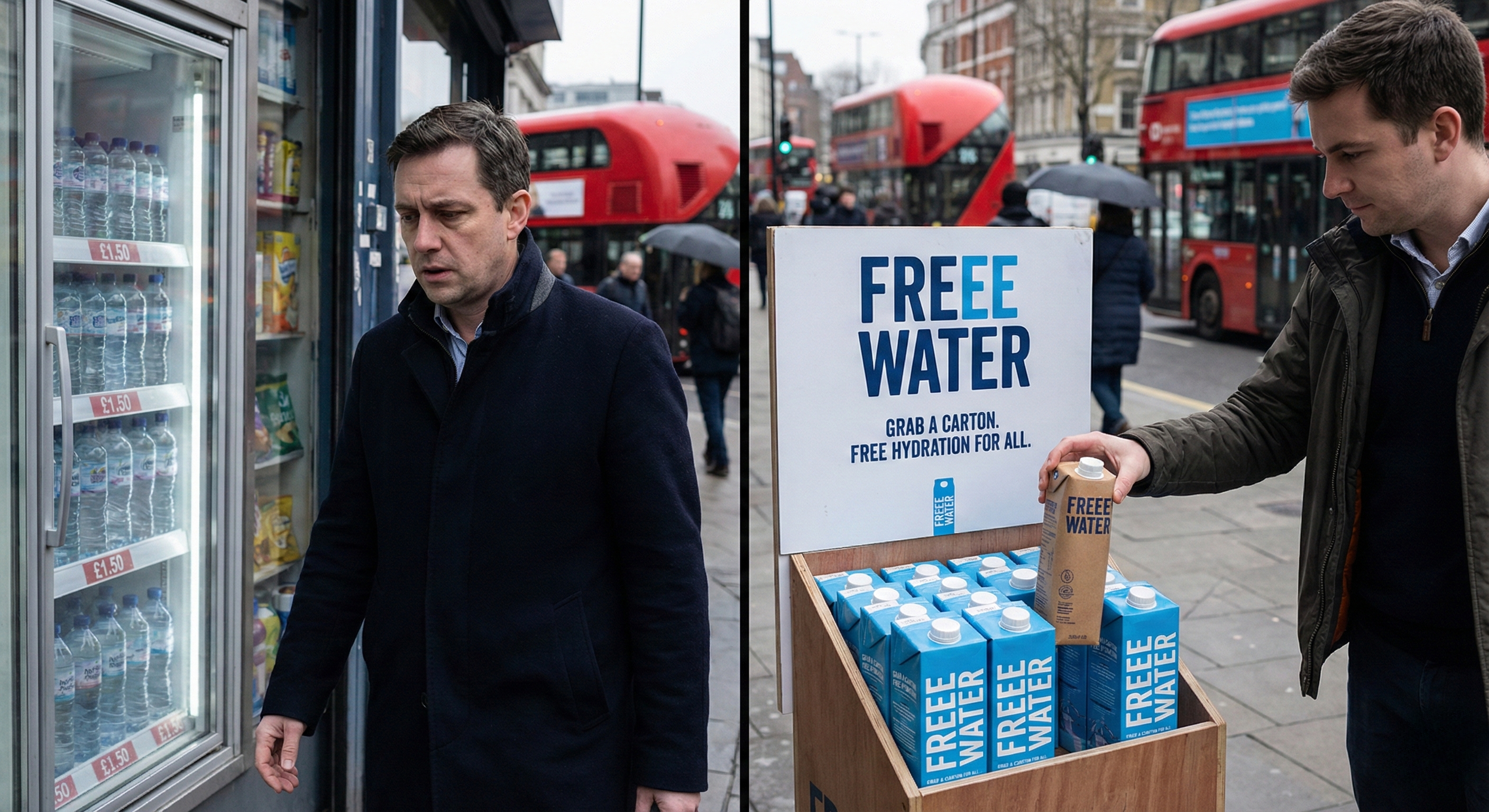
Morning commute: from “grab a bottle” to “grab a carton”
Today
A lot of mornings start with the same small decision:
- Pay £1–2 for a bottle of water at the station
- Skip it and hope there is a tap or refill point later
If you are already counting every pound, that drink often loses.
With Freee Water
On the platform or outside the station, a Freee Water stand offers eco-friendly cartons funded by brand adverts on the packaging. The public can:
- Pick up a carton on the way to the train
- Drink on board without worrying about price
- Refill a reusable bottle later on
Hydration becomes part of the journey, not a luxury line in the budget.
At work: beyond the office kitchen
Many workplaces have water coolers or kitchen taps. Plenty do not.
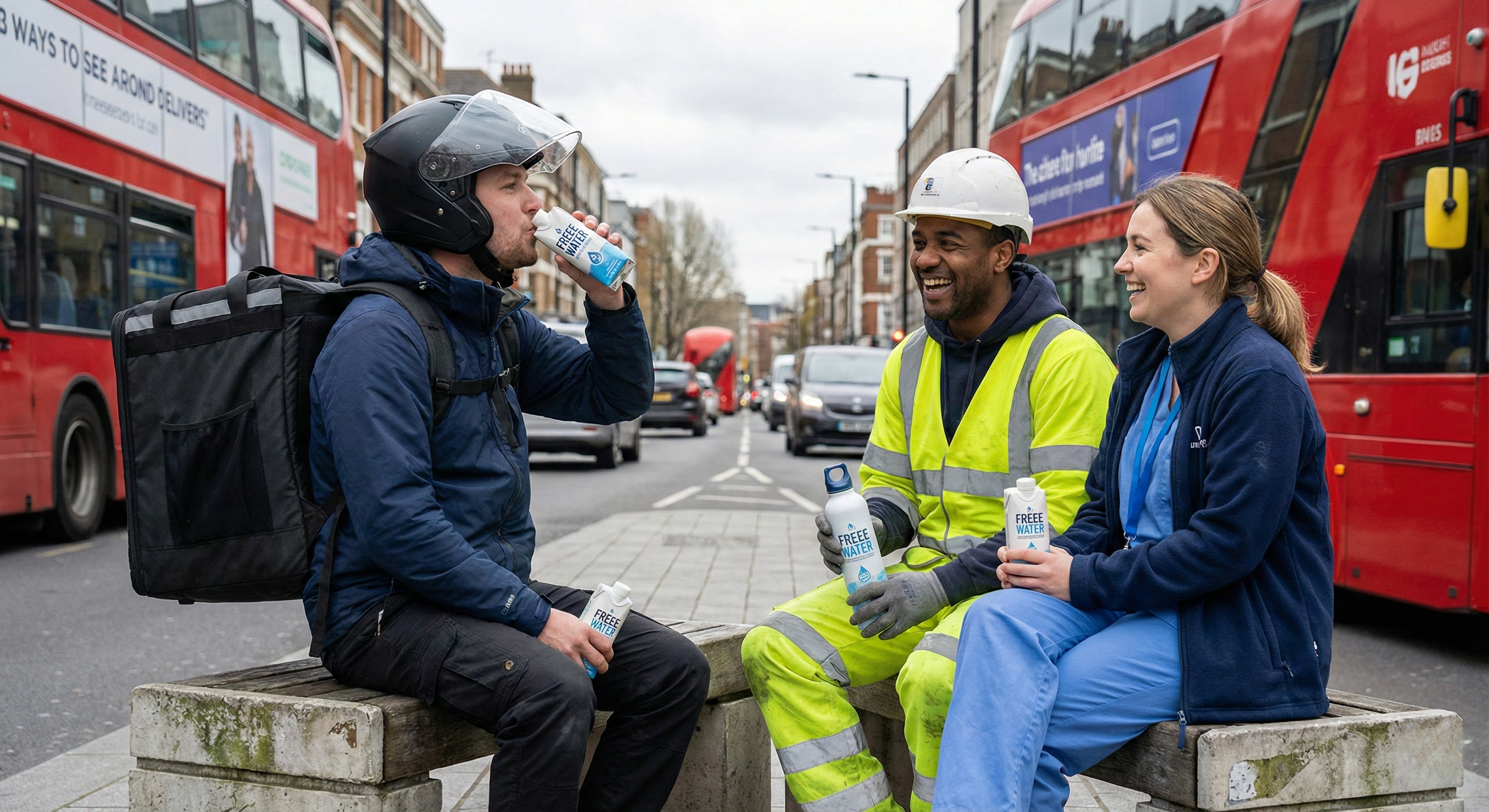
Delivery drivers, retail staff, cleaners, carers, construction workers and gig-economy couriers spend their days on the move.
Today
If you do not bring water from home, the options are:
- Buy another plastic bottle
- Hope there is a friendly café that will fill a cup
- Go without
With Freee Water
Freee Water CIC can place stands at:
- Transport hubs
- Busy pedestrian routes
- Industrial estates and logistics areas
- Shared public spaces near workplaces
Free drinking water moves closer to frontline workers and mobile staff. Brands get visibility in high-footfall areas; people get hydration where they actually work.
School run and after-school activities
Children and young people are heavily affected by food and water insecurity, especially in the cost of living crisis.
Today
On the way home:
- A child asks for a drink
- The parent checks their balance
- Sometimes the answer is “no”, even for water
With Freee Water
Near bus stops, parks, youth spaces and community sports areas, Freee Water stands would allow:
- Children and parents to grab water free of charge
- Youth workers and volunteers to offer hydration without dipping into their own pockets
- Brands to support families directly in the places they already use every day
Dignity matters here. No forms, no sign-ups, no questions, just free water.
Evenings and events
Even small trips out can get expensive quickly: cinemas, community events, casual meet-ups.
Today
Buying water at events often costs as much as a small meal. People:
- Drink less than they should
- Switch to cheaper sugary drinks
- Go home uncomfortable and dehydrated
With Freee Water
Freee Water CIC can integrate into:
- Local festivals and street events
- Community sports matches
- Evening gatherings in high-footfall areas
A mix of eco cartons and reusable bottle models can keep people hydrated for free while brands gain high-engagement visibility.
The bigger shift: hydration as infrastructure, not impulse purchase
The real change Freee Water CIC is working toward is simple:
- Hydration moves from “if I can afford it” to “it’s just there”.
- Brands move from passive adverts to funding something people physically use.
- Public health, fairness and environmental impact all improve together.
A day with Freee Water is not dramatic.
It is just a day where fewer people quietly go without water because the price and access barrier has been removed.
That is the point.
Freee Water CIC is a UK Community Interest Company building that model:
brands pay for the packaging, operations and distribution, so the public drinks for free.
UK Regulatory & Legal Framework for Public Water Access
Public hydration access across the United Kingdom operates within a fragmented statutory environment. Under The Licensing Act 2003 (Mandatory Licensing Conditions) Order 2014, licensed on-trade premises such as pubs, bars, and restaurants are legally required to provide free potable tap water to customers where reasonably available. However, because this legal mandate applies exclusively to paying or recognized patrons, it inadvertently establishes an exclusionary “pay-to-function” commercial barrier for the broader public navigating high streets, public transport corridors, and town centres.
According to nationwide behavioral data published by Refill UK and the City to Sea campaign, over 71% of UK consumers feel acute psychological stigma and social hesitation when requesting free tap water in commercial venues without making a purchase. Furthermore, under the Water Industry Act 1991 (Sections 181 and 182) and guidance from the Drinking Water Inspectorate (DWI), municipal local authorities bear no statutory duty to install or maintain public outdoor drinking fountains. Faced with severe budgetary deficits, local councils frequently decommission municipal water fountains due to winter freezing liabilities, pipework deterioration, legionella testing requirements, and anti-social behavior risks.
Hydration Channel & Economic Footfall Comparison
To examine why conventional public infrastructure struggles to provide reliable, stigma-free hydration across UK urban centres, we compare the primary access channels across physical accessibility, consumer friction, and municipal maintenance:
| Hydration Channel | Accessibility / Cost | Stigma Level | Maintenance Burden |
|---|---|---|---|
| Commercial Venues (Cafes/Pubs) | “Pay-to-function” barrier (£2.50–£4.50 purchase barrier) | High (71% social hesitation) | Low (Customer-funded hospitality staff) |
| Municipal Fountains | Free, but high freeze, lead-pipe & vandalism risk | Low | High Council Maintenance & Winter Shutdowns |
| FreeeWater Faith / Community Mesh | 100% Free, Heated, Staffed & Welcoming | Zero Stigma (Open-Door Civic Hospitality) | Community-Partnered & Sponsor-Funded |
Civic Infrastructure Topology & Community Mesh Flow
The FreeeWater community mesh leverages existing civic architecture, faith institutions, municipal libraries, and community hubs to distribute free hydration with zero taxpayer expenditure. By situating sustainable paper-carton dispensers directly inside community warm spaces, the network solves both physical access constraints and social stigma.
[ Local Resident / Passerby ] ──► [ Faith / Community Hub ] ──► [ FreeeWater Dispenser ]
                                         │                              │
                                         ▼                              ▼
                              [ Warm Space & Dignity ]      [ Zero Plastic Waste ]
Operational Lifecycle & Verified Environmental Impact
Civic hydration initiatives often falter during operational scaling due to plumbing maintenance overheads and regulatory water safety compliance. When traditional outdoor fountains freeze or become contaminated, local councils face months of procurement delays. The FreeeWater ecosystem bypasses centralized utility gridlocks by supplying pre-packaged, hermetically sealed paperboard cartons directly to verified distribution hubs.
Every FreeeWater unit is packaged in FSC-certified paperboard laminated with a thin plant-based barrier, generating 64% fewer greenhouse gas emissions across its lifecycle than standard virgin PET bottles. Ethical brand partners sponsor the outer packaging canvas, turning essential public utility into a high-recall communication channel. In turn, 10p from every distributed carton is transferred directly to the Feed and Flow Foundation to build permanent clean water infrastructure globally.
Oliver Green
Verified AuthorLead Technical Writer & Civic Hydration Specialist • FreeeWater Impact Research
Lead technical writer and community infrastructure analyst at FreeeWater. Researching civic hydration accessibility, UK water regulatory policy, circular packaging lifecycle analysis, and community-driven utility models.
Explore Related Hydration Dispatches
Continue reading connected technical guides and community case studies.
Hydration For The People Who Keep Cities Moving: Freee Water And Frontline Workers In The UK
Daily Every day, UK cities run on the effort of people who rarely appear in glossy campaigns: delivery drivers...
Hotter Summers, Thirstier Cities: How Freee Water Can Support The UK In A Warming Climate
The UK is getting hotter. Recent summers have brought record temperatures, heat warnings and new pressures on ...
The Hydration Postcode Gap: Why Freee Water Focuses On Places The System Forgot
Hydration In the UK, access to water is supposed to be simple. Turn on the tap at home, job done. The reality ...