
Freee Water For Workplaces: Staff Wellbeing With Public Impact
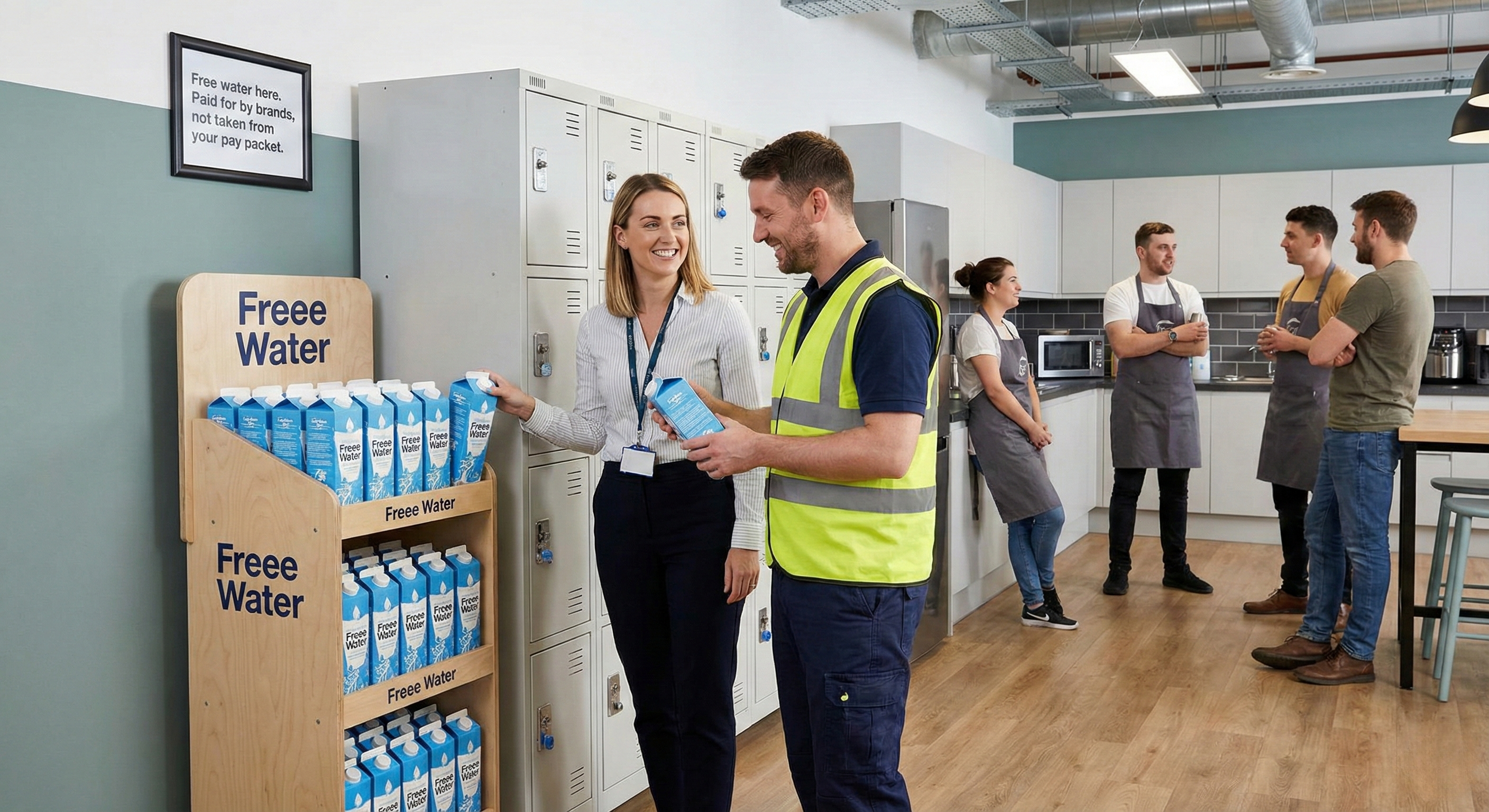
// NO DESCRIPTION DATA
Employers
Most employers talk about looking after their people.
Fewer turn hydration into something practical rather than a poster in the kitchen.
Freee Water CIC offers a way for workplaces to:
- Support staff with free drinking water during the day
- Reduce plastic waste from vending machines and bulk orders
- Contribute to wider public hydration through the same model
It turns “we care about wellbeing” into something that sits directly in people’s hands.
Why hydration is a workplace issue
Dehydration is linked to:
- Tiredness and headaches
- Reduced concentration and performance
- Higher risk of heat stress in hot environments
- Poor mood and irritability
In offices, this shows up as foggy afternoons and extra coffee.
In warehouses, kitchens, construction and outdoor work, it can be dangerous.
Relying on staff to bring their own bottles and remember to refill them is easy for a policy document. It is less reliable on a hectic shift, a split site job or a long day in transit.
Providing free water within the workplace is a simple baseline.
Where Freee Water fits
Freee Water does not replace mains water. It adds:
- Brand funded eco cartons that staff can grab quickly
- Reusable bottles that can be filled at taps or dispensers
- The option for employers to co sponsor cartons used on their sites or nearby public stands
This works for:
- Warehouses and depots with limited kitchen access
- Retail and hospitality sites where staff breaks are short and pressured
- Offices that want a more visible wellbeing offer
- Co working spaces and campuses with shared services
Instead of another vending machine, workplaces can host a Freee Water stand or integrated dispenser point.
Staff benefit on site, community benefit outside
Because Freee Water is a Community Interest Company, its model is designed to generate community benefit beyond the initial carton.
Over time, as the system grows:
- Surplus from brand funded water helps support food projects through Feed & Flow Foundation
- Public stands in streets and stations benefit from the same underlying structure
- Employers can point to a clear social impact link, not just an internal perk
This allows companies to align:
- Staff wellbeing
- Environmental responsibility
- Local social impact
with one practical decision.
Reducing plastic in the workplace
Many workplaces still rely on:
- Pallets of bottled water for events and visitors
- Single use cups near water coolers
- Branded bottles for staff incentives that are rarely used long term
Freee Water offers a cleaner alternative:
- Cartons with a high paper content for short term needs
- Simple reusable bottles for ongoing use
- Messaging that encourages staff to refill rather than throw away
Employers reduce waste at site level, while giving people a clear, consistent way to stay hydrated.
A simple way to start
Workplaces can engage with Freee Water in stages:
- Internal use
- Host a Freee Water point on site for staff and visitors.
- Replace part of the bottled water budget with brand funded cartons.
- Local co sponsorship
- Co sponsor Freee Water stands in nearby public locations such as station approaches or high streets.
- Feature the company logo on a portion of cartons, linking everyday advertising with something people genuinely need.
- Storytelling and reporting
- Share simple impact metrics with staff, such as plastic avoided or litres provided.
- Connect internal wellbeing communications with the external community story.
Hydration is not the only part of staff wellbeing, but it is one of the easiest to act on.
Freee Water turns that action into something bigger than one building.
UK Regulatory & Legal Framework for Public Water Access
Public hydration access across the United Kingdom operates within a fragmented statutory environment. Under The Licensing Act 2003 (Mandatory Licensing Conditions) Order 2014, licensed on-trade premises such as pubs, bars, and restaurants are legally required to provide free potable tap water to customers where reasonably available. However, because this legal mandate applies exclusively to paying or recognized patrons, it inadvertently establishes an exclusionary “pay-to-function” commercial barrier for the broader public navigating high streets, public transport corridors, and town centres.
According to nationwide behavioral data published by Refill UK and the City to Sea campaign, over 71% of UK consumers feel acute psychological stigma and social hesitation when requesting free tap water in commercial venues without making a purchase. Furthermore, under the Water Industry Act 1991 (Sections 181 and 182) and guidance from the Drinking Water Inspectorate (DWI), municipal local authorities bear no statutory duty to install or maintain public outdoor drinking fountains. Faced with severe budgetary deficits, local councils frequently decommission municipal water fountains due to winter freezing liabilities, pipework deterioration, legionella testing requirements, and anti-social behavior risks.
Hydration Channel & Economic Footfall Comparison
To examine why conventional public infrastructure struggles to provide reliable, stigma-free hydration across UK urban centres, we compare the primary access channels across physical accessibility, consumer friction, and municipal maintenance:
| Hydration Channel | Accessibility / Cost | Stigma Level | Maintenance Burden |
|---|---|---|---|
| Commercial Venues (Cafes/Pubs) | “Pay-to-function” barrier (£2.50–£4.50 purchase barrier) | High (71% social hesitation) | Low (Customer-funded hospitality staff) |
| Municipal Fountains | Free, but high freeze, lead-pipe & vandalism risk | Low | High Council Maintenance & Winter Shutdowns |
| FreeeWater Faith / Community Mesh | 100% Free, Heated, Staffed & Welcoming | Zero Stigma (Open-Door Civic Hospitality) | Community-Partnered & Sponsor-Funded |
Civic Infrastructure Topology & Community Mesh Flow
The FreeeWater community mesh leverages existing civic architecture, faith institutions, municipal libraries, and community hubs to distribute free hydration with zero taxpayer expenditure. By situating sustainable paper-carton dispensers directly inside community warm spaces, the network solves both physical access constraints and social stigma.
[ Local Resident / Passerby ] ──► [ Faith / Community Hub ] ──► [ FreeeWater Dispenser ]
│ │
▼ ▼
[ Warm Space & Dignity ] [ Zero Plastic Waste ]
Operational Lifecycle & Verified Environmental Impact
Civic hydration initiatives often falter during operational scaling due to plumbing maintenance overheads and regulatory water safety compliance. When traditional outdoor fountains freeze or become contaminated, local councils face months of procurement delays. The FreeeWater ecosystem bypasses centralized utility gridlocks by supplying pre-packaged, hermetically sealed paperboard cartons directly to verified distribution hubs.
Every FreeeWater unit is packaged in FSC-certified paperboard laminated with a thin plant-based barrier, generating 64% fewer greenhouse gas emissions across its lifecycle than standard virgin PET bottles. Ethical brand partners sponsor the outer packaging canvas, turning essential public utility into a high-recall communication channel. In turn, 10p from every distributed carton is transferred directly to the Feed and Flow Foundation to build permanent clean water infrastructure globally.

Oliver Green
Verified AuthorLead Technical Writer & Civic Hydration Specialist • FreeeWater Impact Research
Lead technical writer and community infrastructure analyst at FreeeWater. Researching civic hydration accessibility, UK water regulatory policy, circular packaging lifecycle analysis, and community-driven utility models.
Explore Related Hydration Dispatches
Continue reading connected technical guides and community case studies.

From Pilot To Network: How Freee Water Could Grow Across A City
Free Water It is one thing to put a single stand of free water on a busy street. It is another to build a reli...

Councils, Transport And Free Hydration: How Freee Water Can Support Public Space
Local councils Local councils and transport operators are expected to do everything at once. Keep streets clea...

The Hydration Postcode Gap: Why Freee Water Focuses On Places The System Forgot
Hydration In the UK, access to water is supposed to be simple. Turn on the tap at home, job done. The reality ...